
Waveforms are at the root of most sounds in synthesis. They’re the shapes that visualize sound, the blueprints of tone, and the building blocks of everything your modular synthesizer creates. From the smooth serenity of a sine wave to the hollow buzz of a square wave, each waveform has a unique sound.
But what makes a sawtooth honk and a square wave donk? Why does a sine wave sound so pure, and how is the character of each sound shaped? If you’ve ever stared at an oscilloscope wondering what those squiggly lines mean, or how to make them work for you, you’ve come to the right place.
In this guide, I’ll cover:
- The fundamental physics of sound and how it relates to synthesis.
- Key concepts like amplitude, frequency, and harmonics.
- A close look at the four primary waveforms: sine, triangle, square, and sawtooth.
- Some tips for crafting and manipulating these shapes on your modular synth.
Whether you’re a patch pro or just starting your synthesis journey, this guide will help you understand basic waveforms and why they have these shapes. Let’s turn those squiggles into sound.
How sound works
At its core, sound is vibration. It’s the movement of air molecules bumping into one another, creating waves of pressure that ripple through space until they reach your ears. These waves are visualized as shapes: squiggly lines that represent the rise and fall of air pressure over time. In synthesis, sound waves aren’t physical vibrations; they’re electrical signals that oscillate in repeating patterns.
Sound in synthesis
In synthesis, sound waves aren’t created by vibrating physical objects like guitar strings or vocal cords. Instead, they’re generated electronically by oscillators. These devices produce repeating waveforms that mimic the behavior of natural sound waves.
An oscillator is like an electronic piano string. In a piano, thicker strings produce low-pitched notes, while thinner strings create higher-pitched ones. Similarly, an oscillator’s frequency knob lets you control how fast the wave cycles, shaping its pitch.
The force you use to hit a piano key determines its loudness. Oscillators typically output at a consistent amplitude, but you use a VCA to dynamically adjust the volume.
By combining frequency and amplitude, oscillators create the raw material for your patches: waveforms.
Let’s break down the key elements of sound.
Breaking down sound waves
Amplitude
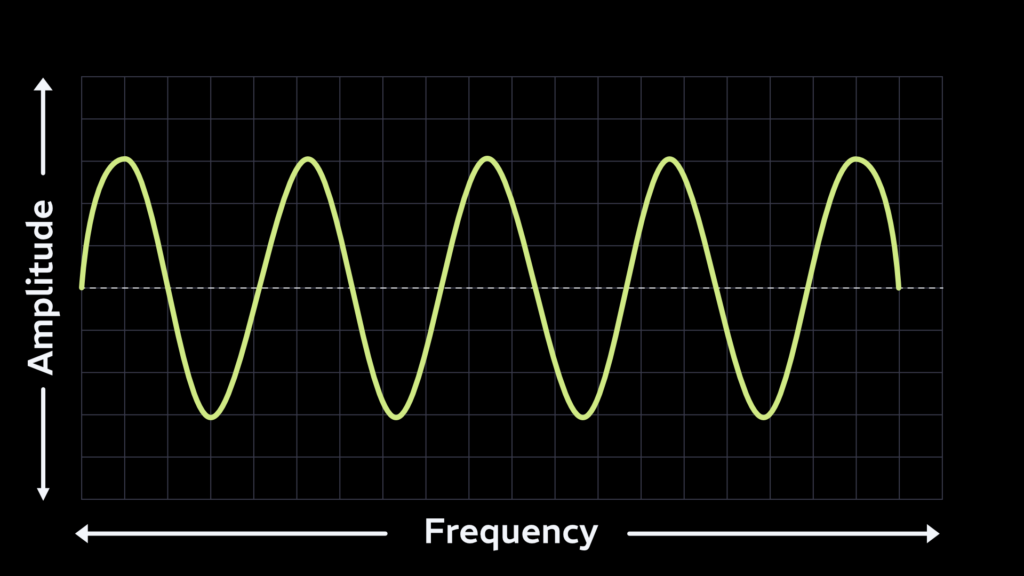
Amplitude is the height of a wave. In audio, this corresponds to loudness: the higher the peaks, the louder the sound. But in synthesis, amplitude also plays a key role in control voltage (CV). For example:
- Higher CV amplitude might push a filter to open wider or drive a VCA into distortion.
- A low-amplitude CV signal might gently wobble pitch for a vibrato effect.
Amplitude shapes dynamics and modulation, defining how bold or subtle your sound feels.
Frequency
Frequency defines how fast a wave oscillates, measured in cycles per second (Hertz or Hz). It determines the pitch of a sound or the speed of modulation. For example:
- A sine wave at 440 Hz produces an A4 note, the standard pitch for tuning orchestras.
- Drop that sine wave to 5 Hz, and it becomes a low-frequency oscillator (LFO), perfect for effects like tremolo or vibrato.
In synthesis, frequency controls the pitch of your oscillators or the rate of an LFO. Faster frequencies produce higher pitches or faster modulations, while slower frequencies create deep bass or slower movements.
Harmonics and timbre
Every sound you hear is made up of a mix of frequencies. While the root note, or fundamental frequency, determines the pitch, it’s the harmonics layered on top that define a sound’s timbre. The unique blend and balance of these harmonics are why a piano playing an A4 sounds different from a violin playing the same note.
What are harmonics?
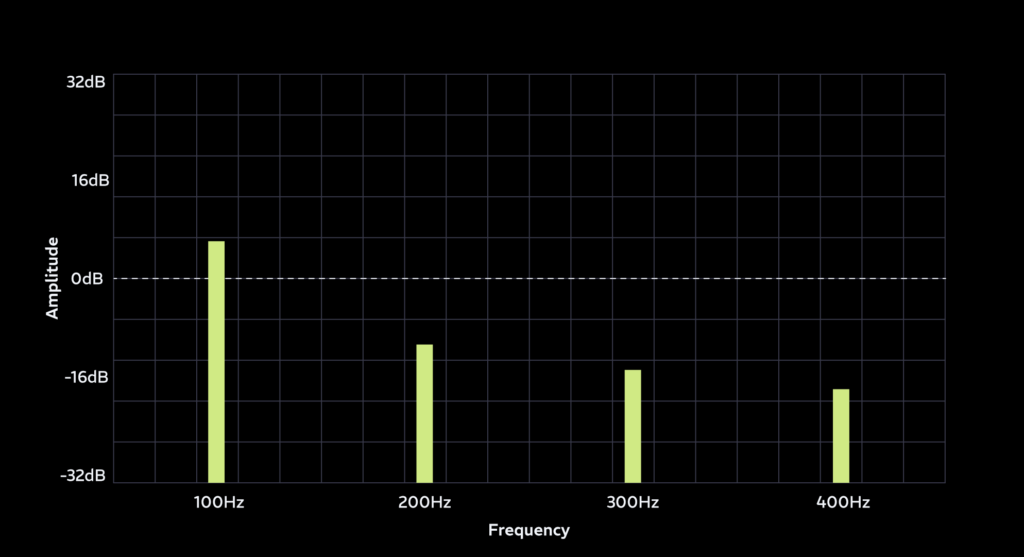
Harmonics are additional frequencies that occur at whole-number multiples of the fundamental frequency. For example, if the fundamental is 100 Hz, harmonics appear at 200 Hz, 300 Hz, 400 Hz, and so on.
As harmonics rise in frequency, their amplitude decreases. This drop-off in amplitude is what makes harmonics blend into the sound’s overall timbre rather than being perceived as separate tones or chords. For example:
- In a triangle wave, higher harmonics (e.g., the 7th and 9th) have such low amplitude that they’re barely audible.
- In a sawtooth wave, harmonics taper off more gradually, creating a rich and brassy character.
Odd vs. even harmonics
Not all harmonics are created equal. Some waveforms include only odd harmonics, while others feature both odd and even harmonics. This difference plays a big role in shaping a waveform’s timbre:
- Odd harmonics: Found in square and triangle waves, they create a hollow, woody tone.
- Even harmonics: Found in sawtooth waves, which have both odd and even harmonics. Even harmonics add richness and brightness.
How harmonics shape timbre
Each waveform has a unique harmonic recipe, which is why each one sounds so different.
Sine wave
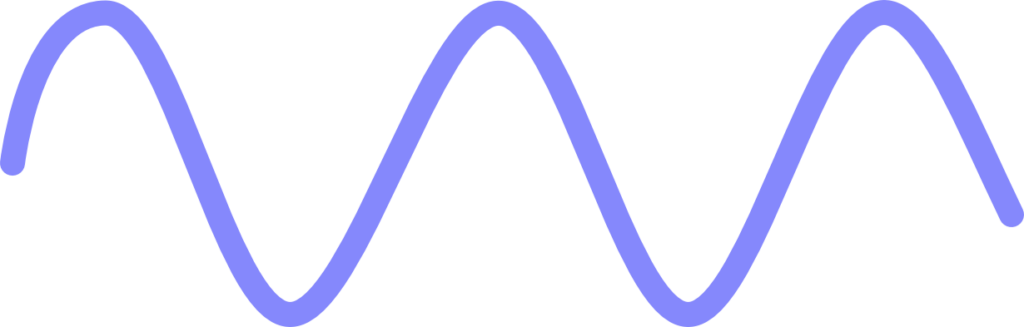
Contains only the fundamental frequency. No harmonics = pure tone. Sounds like a tuning fork, pure and clean.


Square wave
Also includes odd harmonics, but their amplitudes decrease more slowly, making it brighter than a triangle wave but kind of hollow, sort of like a clarinet.

Sawtooth wave
Contains both odd and even harmonics, with amplitudes decreasing linearly. This makes it rich and string-like, think violin.
Visualizing harmonics
If you use a spectrum analyzer (or an EQ that shows the spectrum), found in most DAWs, you can watch harmonics in action. A smooth sine wave has no additional peaks, but as you switch to more complex waveforms, you begin to see the distribution of harmonics.
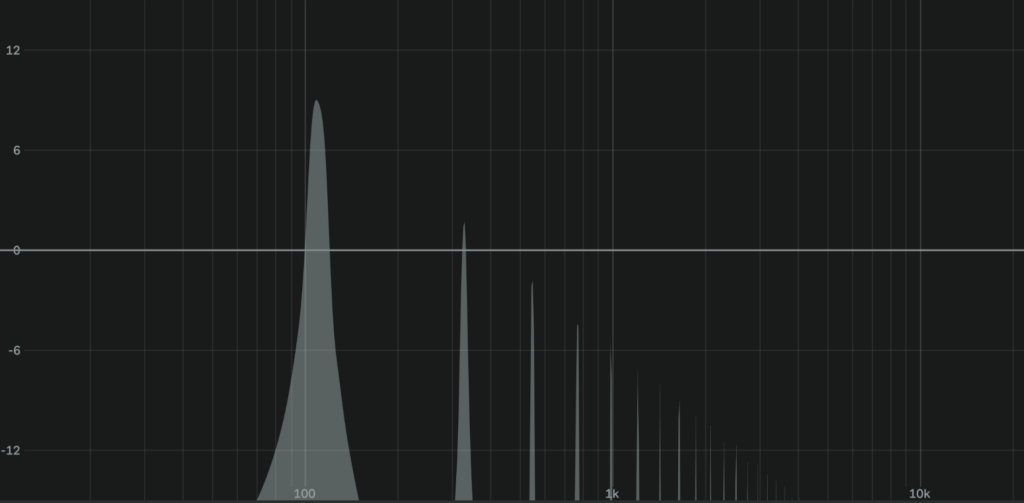
Here are a few modules that will help you visualize waveforms in real time as you manipulate them:
Knobulism recommends
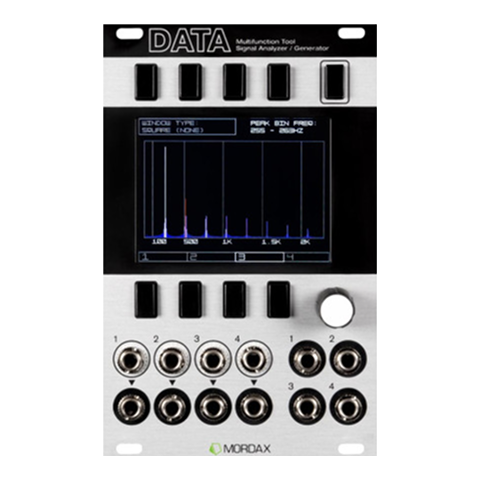
Mordax Data Multifunction Tool
A multifunction utility with oscilloscope, tuner, generator, spectrum display, and clock. Customizable via SD card, it’s packed with precision tools, and feels built for synths.
Perfect Circuit Signal Sounds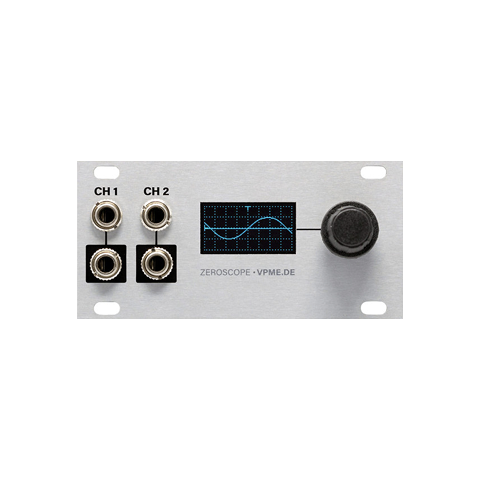
Intellijel Designs Zeroscope
A compact 1U oscilloscope and tuner that slips neatly into any rack. With scope, XY, and tuning modes plus thru outputs, it makes signal checking fast, fun, and unobtrusive.
Perfect Circuit Signal Sounds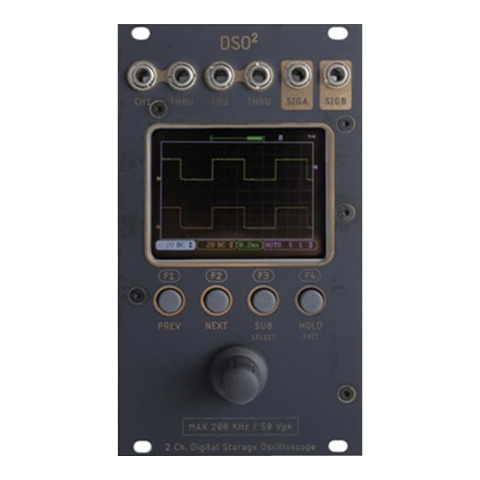
Tall Dog Electronics DSO 2
A dual-channel oscilloscope that lets you watch two signals at once. Buffered I/O keeps the path clean, the display is sharp, and the built-in generator adds waves, offsets, and XY plots for deeper analysis.
Perfect Circuit
vpme.de ZeroScope
A utility oscilloscope with single, dual, and XY modes plus an adjustable timebase. It doubles as a tuner and frequency meter, making oscillator monitoring simple and precise.
Perfect Circuit Signal SoundsManipulating harmonics in synthesis
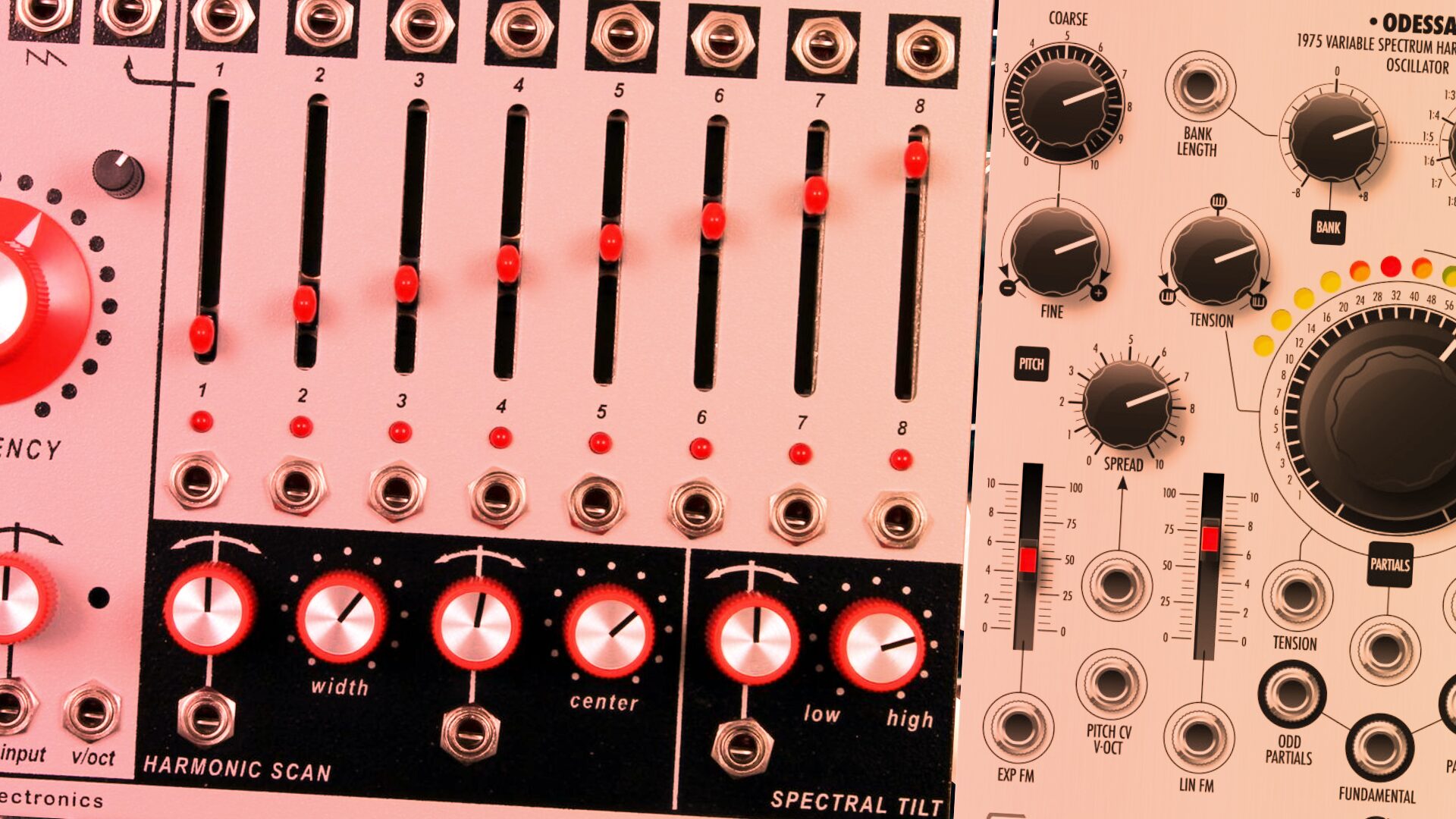
- Adding harmonics: Use additive synthesis to combine sine waves at different frequencies and amplitudes. This lets you craft specific harmonic structures from scratch. With enough sine waves you can create almost any waveform shape. The XAOC Devices Odessa The XAOC Devices Odessa can generate up to 512 simultaneous sine waves and offers other controls to help you position their frequency and amplitude.
- Removing harmonics: Subtractive synthesis techniques, such as filtering, remove higher harmonics to create smoother or darker sounds.
- Dynamic harmonics: Wave shapers, pulse-width modulation, and distortion introduce or amplify harmonics dynamically, adding motion and complexity to your patches.
Experiment: Run a sine wave into a low pass filter and reduce the LPF frequency. You may notice that this has no effect, other than changing the amplitude of the sine wave. That is because a sine wave is a single frequency with no harmonics and does not supply the filter with any additional harmonics to remove.
The four core waveforms
Sine wave
Soft, smooth, and pure. Like the tone of a tuning fork.
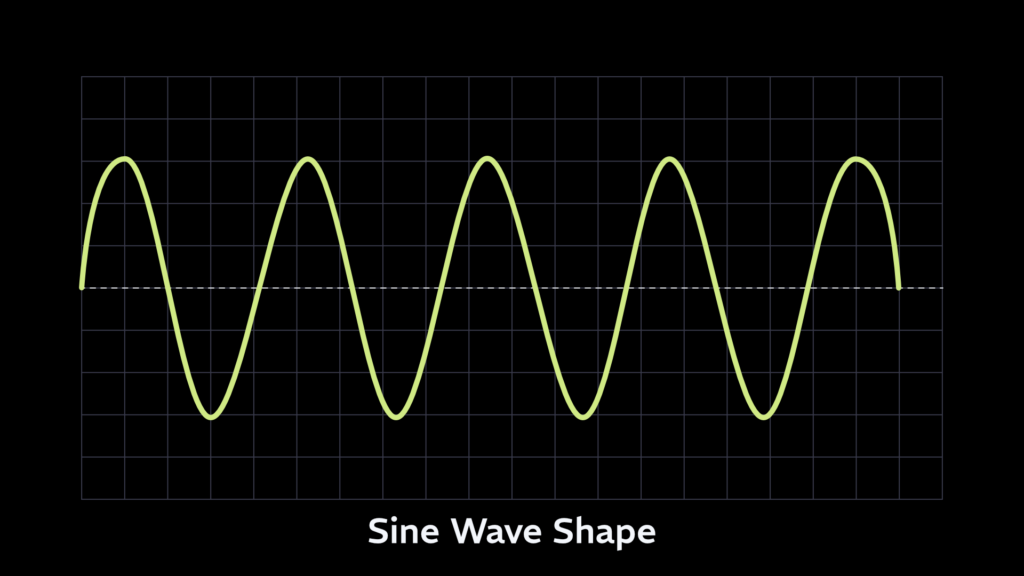
Harmonics: None. The sine wave consists only of the fundamental frequency.
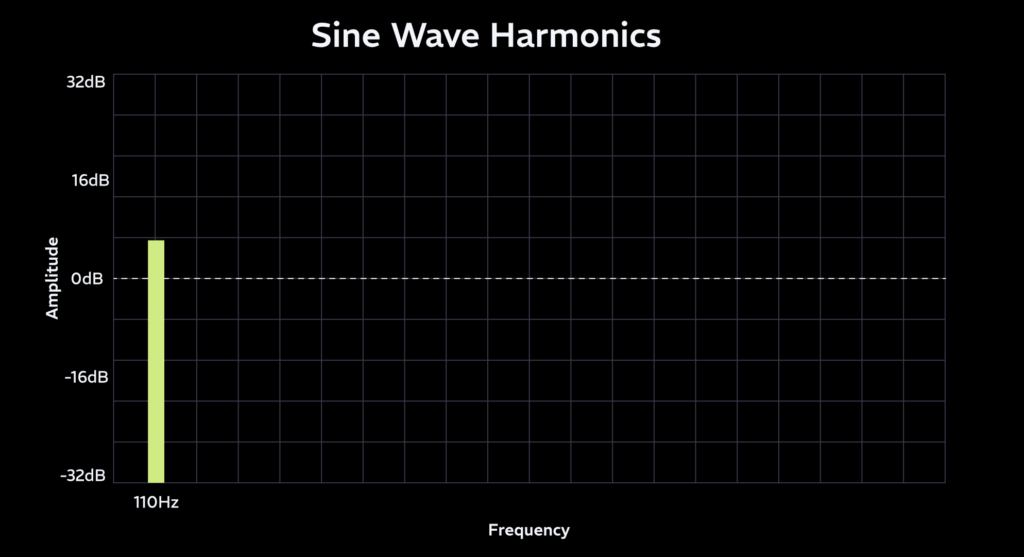
Musical uses: Deep subs, clean beeps, or as a modulation source for vibrato and tremolo.
Quick tip: If you don’t have a sine wave, you can approximate one by filtering higher harmonics from a triangle or square wave using a low-pass filter.
Triangle wave
The triangle wave looks like, um… well, triangles. It’s harmonically richer than a sine wave but still mellow, making it great for soft and subtle sounds. If you want very consistent ramp up then ramp down modulation, a triangle wave is best.
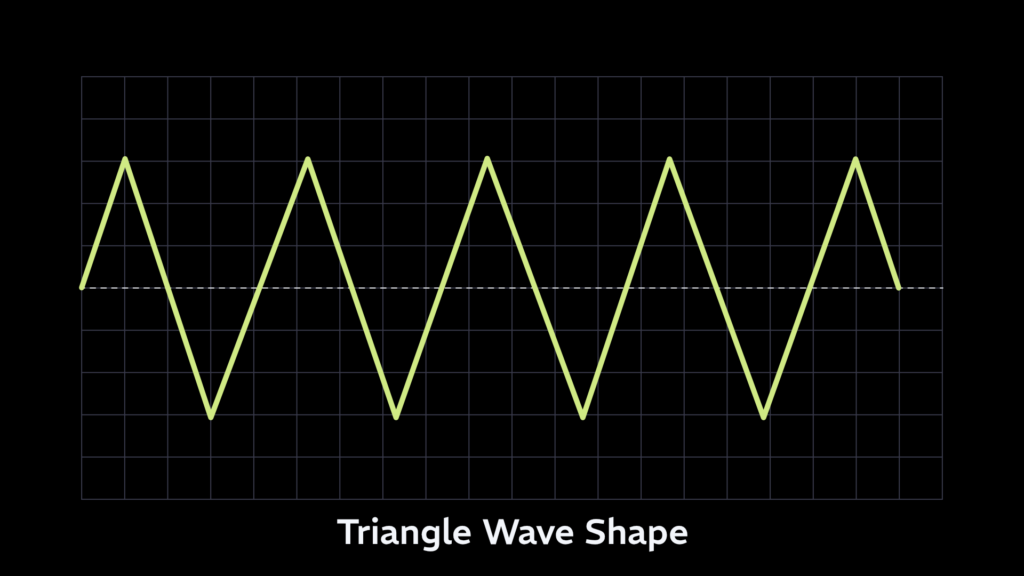
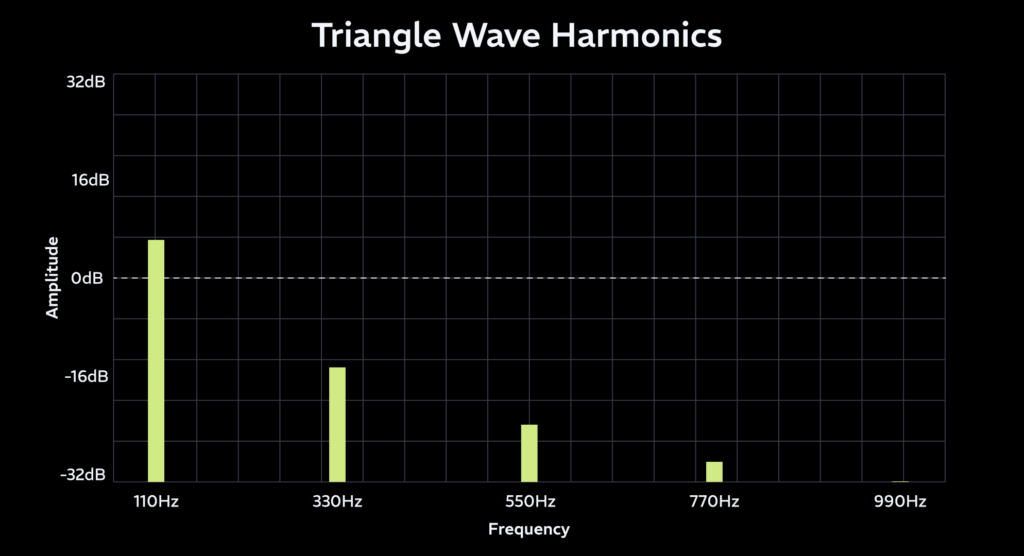
Harmonics: Contains only odd harmonics (3rd, 5th, 7th…), with amplitudes decreasing rapidly by the square of the harmonic number.
To approximate a triangle wave with a fundamental frequency of 110 Hz and a fundamental amplitude of 0 dB, include the following odd harmonics:
- 1st harmonic at 110 Hz with an amplitude of 0.00 dB.
- 3rd harmonic at 330 Hz with an amplitude of approximately -19.08 dB.
- 5th harmonic at 550 Hz with an amplitude of approximately -27.96 dB.
- 7th harmonic at 770 Hz with an amplitude of approximately -33.80 dB.
- 9th harmonic at 990 Hz with an amplitude of approximately -38.17 dB.
Musical uses: Pads, leads, or as an LFO for linear modulation.
Quick tip: Using a wave folder you can transform a sawtooth into a pretty convincing triangle with just a touch of folding.
Square wave
The square wave switches abruptly between high and low voltages, giving it a binary, on-off appearance. This sharp transition creates a bright yet hollow sound. Think classic chiptune music or PWM leads.
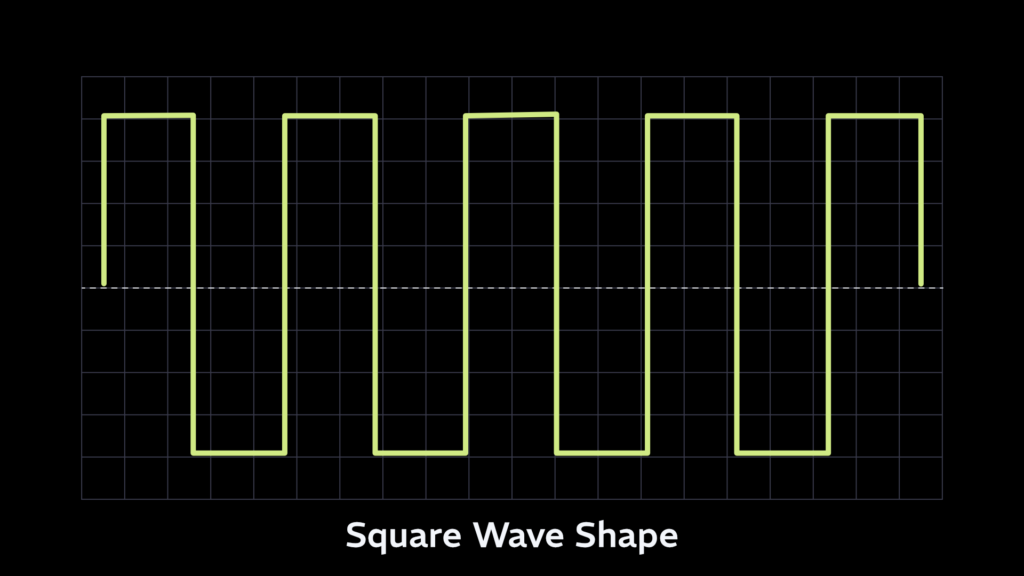
Harmonic breakdown
Harmonics: Odd harmonics only (3rd, 5th, 7th…), with amplitudes that decrease less steeply than in a triangle wave.
To approximate a square wave with a fundamental frequency of 110 Hz and a fundamental amplitude of 0 dB, include the following odd harmonics:
- 1st harmonic at 110 Hz with an amplitude of 0.00 dB.
- 3rd harmonic at 330 Hz with an amplitude of approximately -9.54 dB.
- 5th harmonic at 550 Hz with an amplitude of approximately -13.98 dB.
- 7th harmonic at 770 Hz with an amplitude of approximately -16.90 dB.
- 9th harmonic at 990 Hz with an amplitude of approximately -19.08 dB.
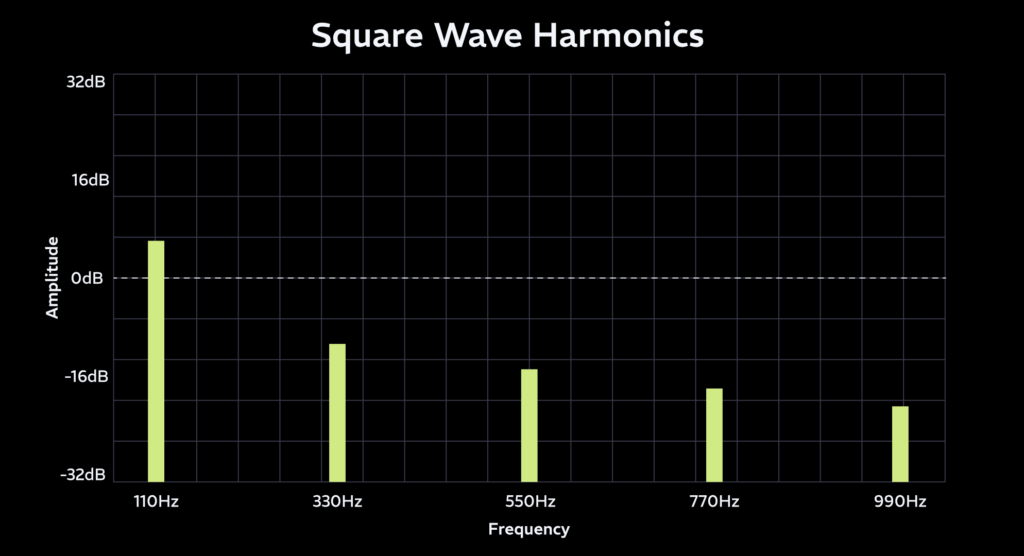
This stronger harmonic presence gives it a brighter sound compared to the triangle wave.
Musical uses: Dynamic basslines, PWM leads, or cutting-edge sounds.
Quick tip: There are lots of ways to make a square wave from other waveforms. One of the easiest is to use an analog clock divider like the Doepfer A-160-2 Doepfer A-160-2. Patch any audio-rate waveform into the input and you’ll get subharmonic square waves at different pitches from each output.
Sawtooth wave: the harmonic heavyweight
The sawtooth wave ramps linearly upward (or downward) before resetting sharply, resembling the teeth of a saw. Its dense harmonic content makes it the richest and most versatile of the four waveforms.
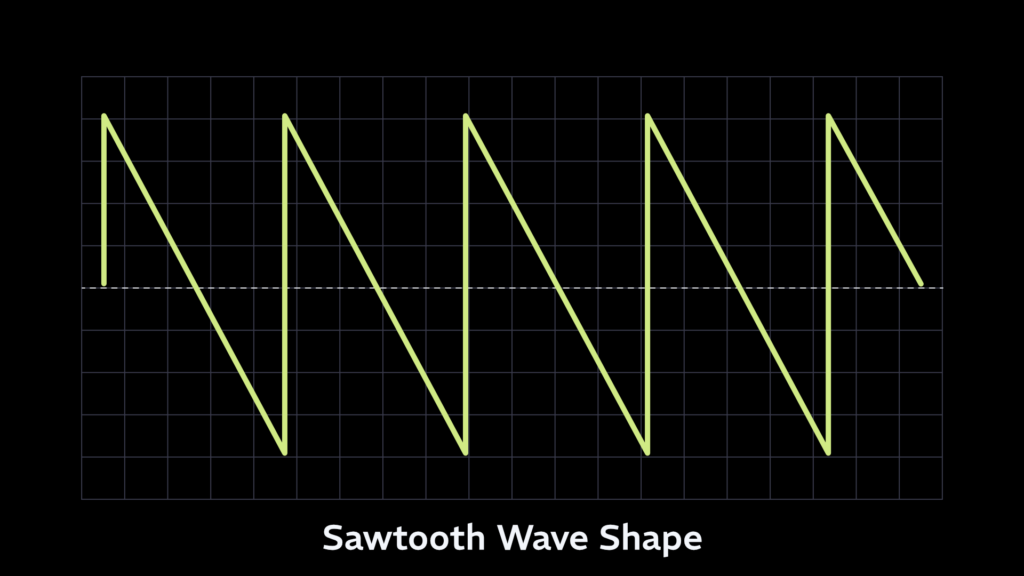
Harmonic breakdown
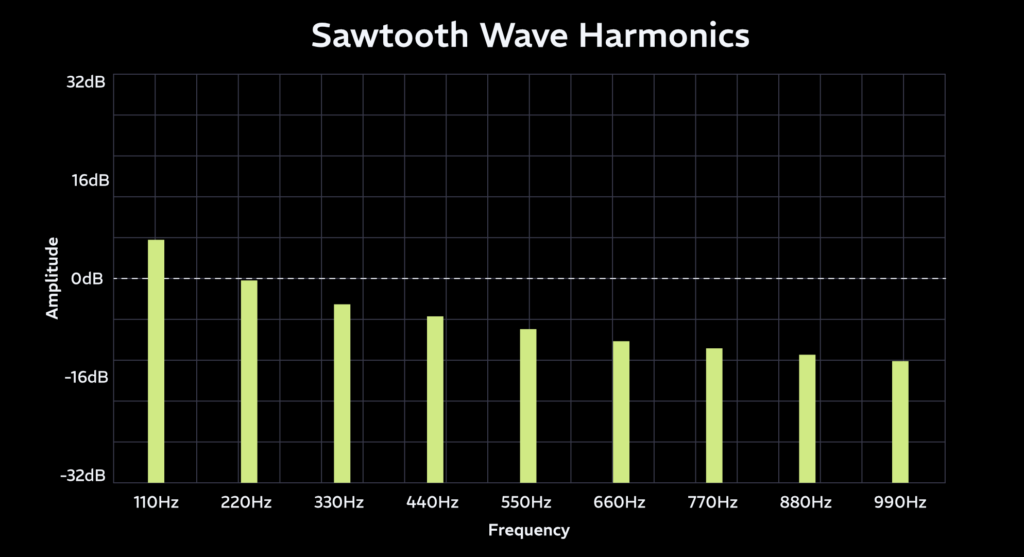
Harmonics: Contains both odd and even harmonics, with amplitudes decreasing linearly.
To approximate a sawtooth wave with a fundamental frequency of 110 Hz and a fundamental amplitude of 0 dB, include the following harmonics:
- 1st harmonic at 110 Hz with an amplitude of 0.00 dB.
- 2nd harmonic at 220 Hz with an amplitude of approximately -6.02 dB.
- 3rd harmonic at 330 Hz with an amplitude of approximately -9.54 dB.
- 4th harmonic at 440 Hz with an amplitude of approximately -12.04 dB.
- 5th harmonic at 550 Hz with an amplitude of approximately -13.98 dB.
- 6th harmonic at 660 Hz with an amplitude of approximately -15.56 dB.
- 7th harmonic at 770 Hz with an amplitude of approximately -16.90 dB.
- 8th harmonic at 880 Hz with an amplitude of approximately -18.06 dB.
- 9th harmonic at 990 Hz with an amplitude of approximately -19.08 dB.
Musical uses: Leads, pads, and subtractive synthesis where harmonic richness is needed.
Quick tip: Make any sawtooth sound thicker by adding another slightly detuned sawtooth. Also, sawtooth is great for sync sounds.
Additive and subtractive synthesis
Waveforms are powerful on their own, but their true potential shines when you combine or sculpt them. Two fundamental techniques, additive synthesis and subtractive synthesis, form the basis of most sound design. These methods let you craft everything from simple tones to complex, evolving textures.
Additive synthesis: building from the ground up
Additive synthesis involves creating complex waveforms by layering simple ones, usually sine waves. Each sine wave represents a single frequency, and by carefully combining them at different frequencies and amplitudes, you can construct rich, harmonic textures.
How it works
- Start with a sine wave, which represents the fundamental frequency.
- Add more sine waves at harmonic frequencies (multiples of the fundamental).
- Control the amplitude of each harmonic to shape the final timbre.
The recipes for the basic waveform shapes are listed above. You need fairly accurate values to pull this off, and for some waveforms every other harmonic needs to be phase inverted. Even with just 5 harmonics, you can hear them start to sound like the real waveforms.
I tested this in VCV Rack as seen below. This and patches from other articles are available to Patreon members.
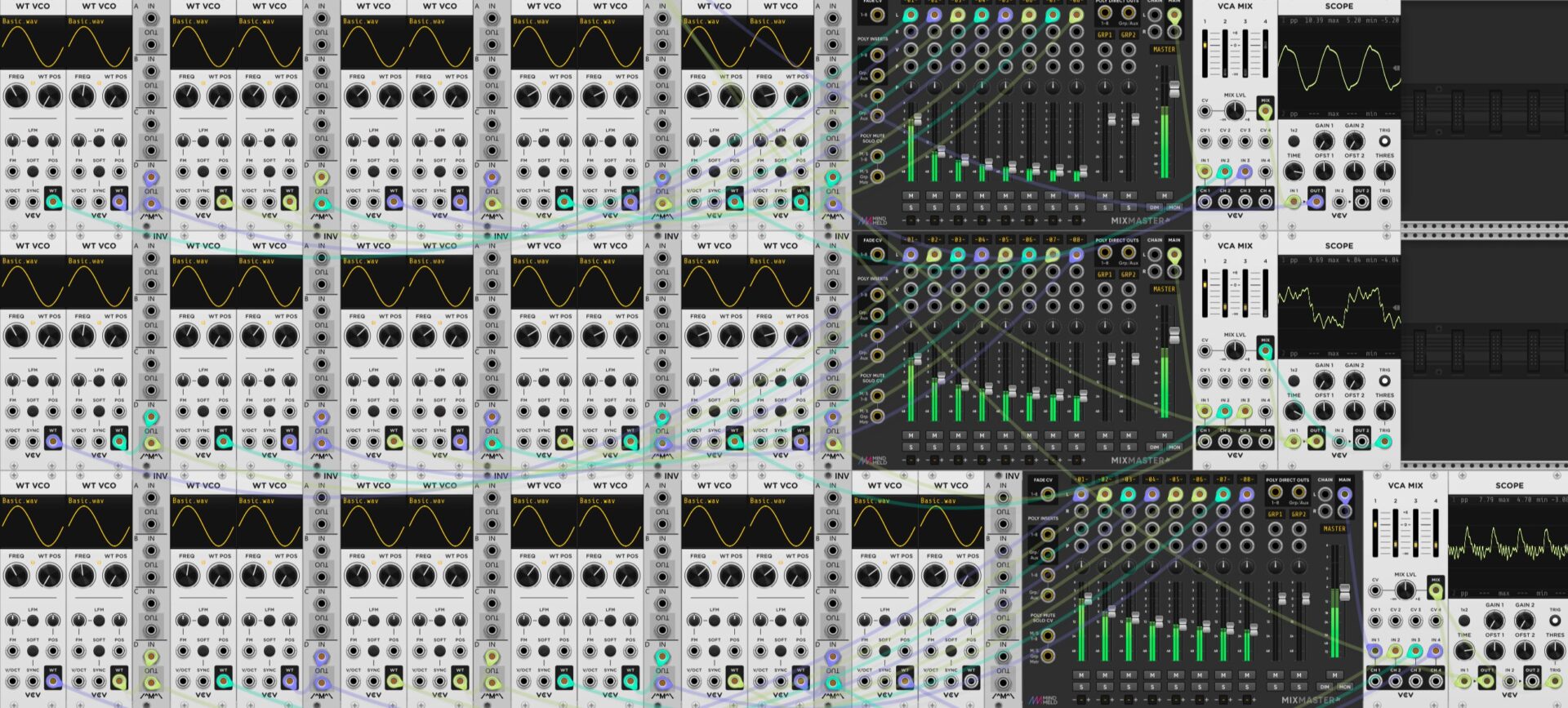
Try this: Patch three oscillators with sine waves at 100 Hz, 200 Hz, and 300 Hz into a mixer. Adjust their amplitudes to hear how harmonics interact and shape the sound.
Subtractive synthesis: carving out tone
Subtractive synthesis starts with a harmonically rich waveform (like a sawtooth or square wave) and sculpts it by removing frequencies. This approach is central to many classic analog synth sounds.
How it works
- Begin with a harmonically rich waveform, like a sawtooth or square wave.
- Use filters to remove (or emphasize) specific frequencies.
- Low-pass filter (LPF): Cuts high frequencies, leaving only the lower, smoother ones.
- High-pass filter (HPF): Removes low frequencies for thinner, brighter sounds.
- Band-pass filter (BPF): Isolates a specific range of frequencies, great for resonant effects.
For example:
- Filter a sawtooth wave to create a mellow pad or string sound.
- Use a resonant low-pass filter to add a vocal-like quality to a square wave.
Modular application
- Dynamic filtering: Patch an envelope or LFO to modulate the filter cutoff, creating evolving textures or rhythmic sweeps.
- Feedback loops: Use feedback to exaggerate resonant peaks for more dramatic effects.
Try this: Start with a sawtooth wave, patch it through a low-pass filter, and connect an envelope generator to the filter’s cutoff. Adjust the envelope’s attack and decay to shape plucky or sweeping tones.
Why these methods matter
- Additive synthesis gives you precise control over harmonics, making it ideal for crafting entirely new timbres or approximating acoustic sounds.
- Subtractive synthesis simplifies sound design by starting with a harmonically dense waveform and sculpting it to fit your needs.
Quick tip: Combine both methods in your modular patches. Layer sine waves for a complex harmonic foundation, then use filters to shape and refine the result.
Wrapping it up
Waveforms are the foundation of synthesis, each with its own unique character and harmonic structure. By understanding the physics of sound, the role of harmonics, and the four core waveforms (sine, triangle, square, and sawtooth), you’ve unlocked the keys to shaping and designing sound.
Recap
- Sound basics: Amplitude and frequency define the shape and behavior of a waveform, determining its loudness and pitch.
- Harmonics: These hidden frequencies are what give waveforms their character. Balancing harmonic amplitudes allows us to perceive them as a single, unified sound.
- Core waveforms: Each waveform brings something unique:
- Sine waves are pure and smooth.
- Triangle waves are soft with a hint of buzz.
- Square waves are bold and hollow.
- Sawtooth waves are rich and brassy.
- Additive and subtractive synthesis: Two essential methods for building and shaping sound.
Experimentation is where synthesis truly comes alive. Mix waveforms, sculpt harmonics, or filter frequencies to create the unique textures and tones that fit your vision.
If this guide sparked your curiosity, sign up for email updates to explore more topics like modulation, patching techniques, and advanced synthesis concepts. And don’t forget to share your favorite waveforms or modular adventures in the comments below. Let’s keep exploring together.


I love your blog. Very informative!
Perhaps one feedback. I often read on mobile, and when I’m scrolling, the terms oftentimes open pop-ups that are inconvenient to close. Some options include moving all term links to the start or end of the article, like a glossary. I can’t seem to avoid pressing the pop-ups multiple times during one article.
Keep up the great work!!
Thanks, I am happy you find it interesting. Thanks for the note about the glossary items. I’ll do some testing and see how I can improve it.
Very helpful! I especially liked the “Try This” and “Experiment” sections which give a simple and practical was to experience the ideas discussed. Thanks so much for this.