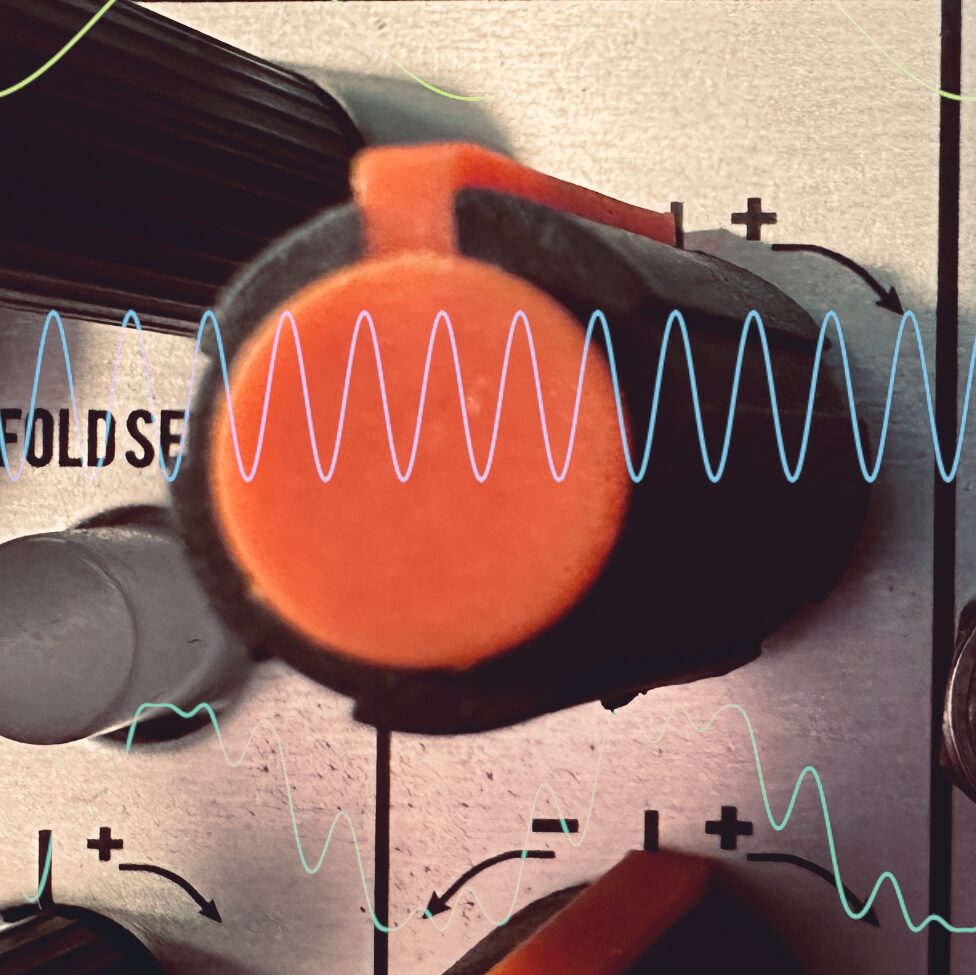
Frequency modulation works by using one oscillator, the modulator, to continuously vary the frequency of another, the carrier. Through-zero FM takes this further: when the modulator pushes the carrier’s frequency all the way down to zero Hz and beyond, the carrier reverses direction. This interactive shows the three signals involved.
The carrier and modulator are independent: changing one has no effect on the other. The output is where their interaction happens. The modulator is what drives the carrier frequency below zero, causing the phase reversal that defines through-zero FM. Depth scales how far the modulator can push the carrier frequency from its center. The greater the deviation, the more sidebands are generated and the more complex the output becomes.
The ratio between the carrier and modulator frequencies determines the character of the output. Integer ratios produce harmonic, musical results. Non-integer ratios produce inharmonic, metallic textures. The further into negative frequency the carrier is pushed, the more the output folds back on itself, producing the complex timbres that through-zero FM is known for.
Linear FM without through-zero
This visualization shows the same setup, but with one key difference: the carrier frequency is not allowed to go below zero Hz. When the modulator pushes hard enough, the instantaneous frequency hits zero and stops there rather than crossing into negative territory.
The instantaneous frequency row makes this visible. At low depth settings the behavior looks similar to through-zero FM, but as you increase depth you can see the frequency line flatten against zero. During that flattened stretch the oscillator stalls and the output holds a constant value, which adds a DC offset. The lost negative swings also push the carrier’s average frequency up, so the pitch drifts sharper as you increase depth. That drift is what linear FM without through-zero is known for, and it’s why through-zero is considered the more correct implementation.
Special thanks to Kahmpur for helping me wrap my head around some finer details of through-zero FM.