
Is your mix a thick, sticky, and shapeless blob, like someone submerged your monitors in pudding? Notes blur, rhythms are flabby, and everything melts into one gloopy mess. Well, the fix usually isn’t tearing your whole patch apart. It’s just a few smart tweaks that give each voice space to shine without bleeding into each other. Let’s carve up that amorphous sound mass and get your patch snapping.
Start with frequency separation
Look at each of your voices. How do they sit in the frequency spectrum? Does your pad carry unnecessary low end? Is your bass competing with a subby kick? Does your lead overlap the same midrange as your pad?
Your filters aren’t just for shaping timbre; they’re good for EQ too. If you’re using low-pass or high-pass filters, try switching to a bandpass instead. Keep the overall character close, but center the focus. Bandpass filters are often overlooked, but they can do wonders for clarity. Their typically gentler slope preserves more top and bottom, while still narrowing the frequency range and helping voices stay out of each other’s way.
This chart shows general frequency ranges that contribute to mix clarity. It’s not meant to lock sounds into specific bands, but rather to give you a rough idea of what lives where. Use it as a shaping guide, not a rulebook.

For example, with a bass sound, I’ll usually start with a low-pass filter set around 100 to 300 Hz. Then I’ll modulate that filter with an envelope so it opens briefly to somewhere between 1 kHz and 3 kHz on each note. That short burst adds transient definition, but since the filter doesn’t stay open, it won’t crowd out higher-frequency voices for long.
For a more mid-range sound, I’ll usually choose a bandpass, but sometimes I’ve found that a few well-placed 4hp filters around your system work great for this kind of cleanup. 4hp is the sweet spot, small enough to fit anywhere, but still roomy enough for a full-featured multi-mode filter without a cramped interface.
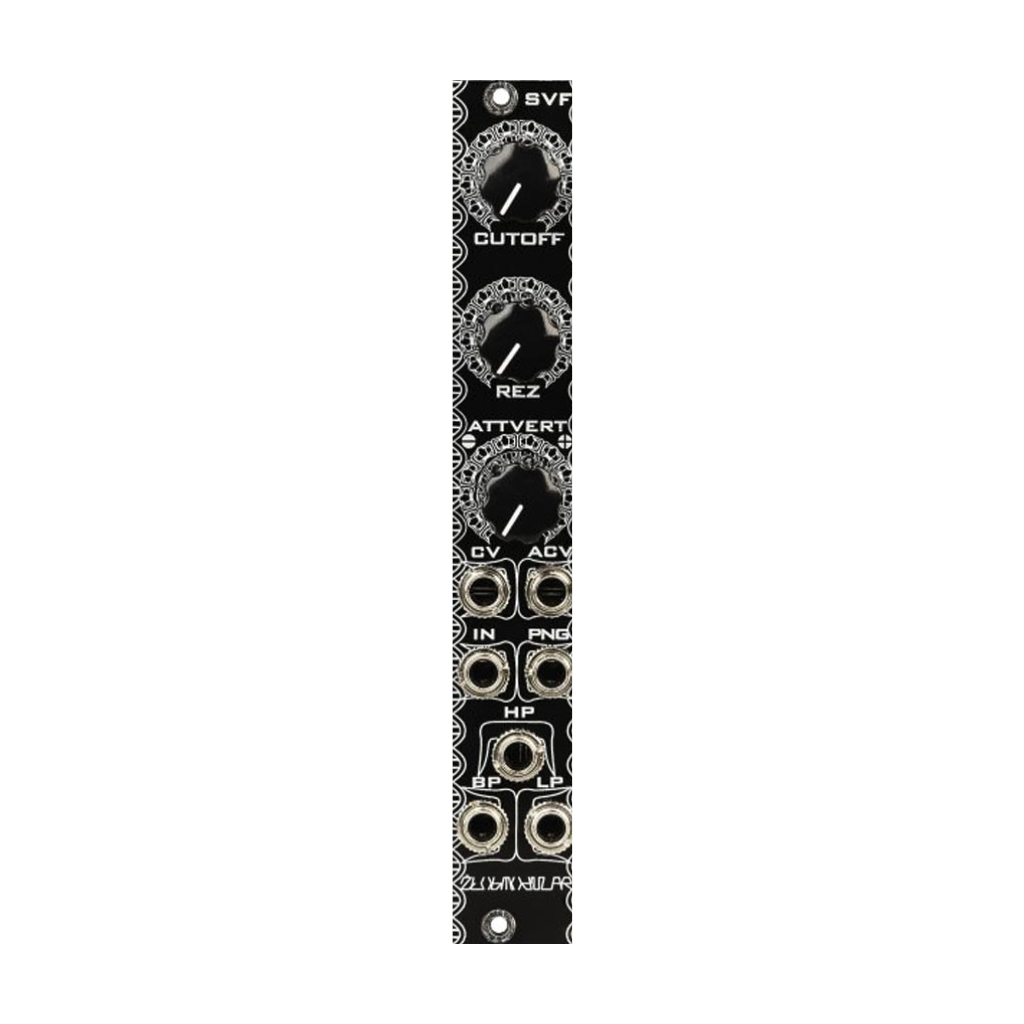
Zlob Modular SVF
A 4HP, 12dB state variable filter with low pass, band pass, and high pass outputs drawn from WASP and Thomas Henry designs. Jumpers take it from clean and clinical to juicy, pingable plonks or screaming self-oscillation. Two inputs and an attenuverted CV make a lot of filter in a tiny footprint.
Perfect Circuit Signal SoundsChill the fuck out with the reverb!
Stop drowning everything in reverb! Seriously, cut it out. You think it sounds good? I’m sorry to be harsh, but it sounds amateurish. Try turning off the reverb for a moment. Still like your patch? No? Then you’re using reverb as a crutch, just faking depth to make something flat seem interesting.
Reverb can add space and depth, but too much makes your mix feel like it’s gasping for air. Dial it back. Use shorter decay times unless you’ve got a clear reason to go long. If you’re running more than one reverb, assign them different jobs. Maybe a short decay or gated reverb for percussion, and a longer, but not infinite, tail for melodic elements.
Another fix: filter the sub out of your reverb to kill off all that low-end sludge. Roll off a little high end too, to avoid a constant hiss floating in your mix. And yep, bandpass filters can help here too. Try one before the reverb and see if it tightens things up. It won’t work in every patch, but when it does, it makes a big difference.
A slightly less common but super effective way to rein in your reverb is to sidechain the wet/dry mix, or even the decay time. This pulls back the reverb on each gate and adds a subtle pumping effect. Just mult a gate from your kick or other source sound into an attack-decay envelope with a slow attack and long decay, then patch that into your reverb’s CV input for wet/dry or decay. Tweak the envelope to taste.
Some folks will tell you to use an envelope follower and invert it. Others will suggest compressors or even a dedicated sidechain module. Honestly? The best move is a single-segment ramp envelope.
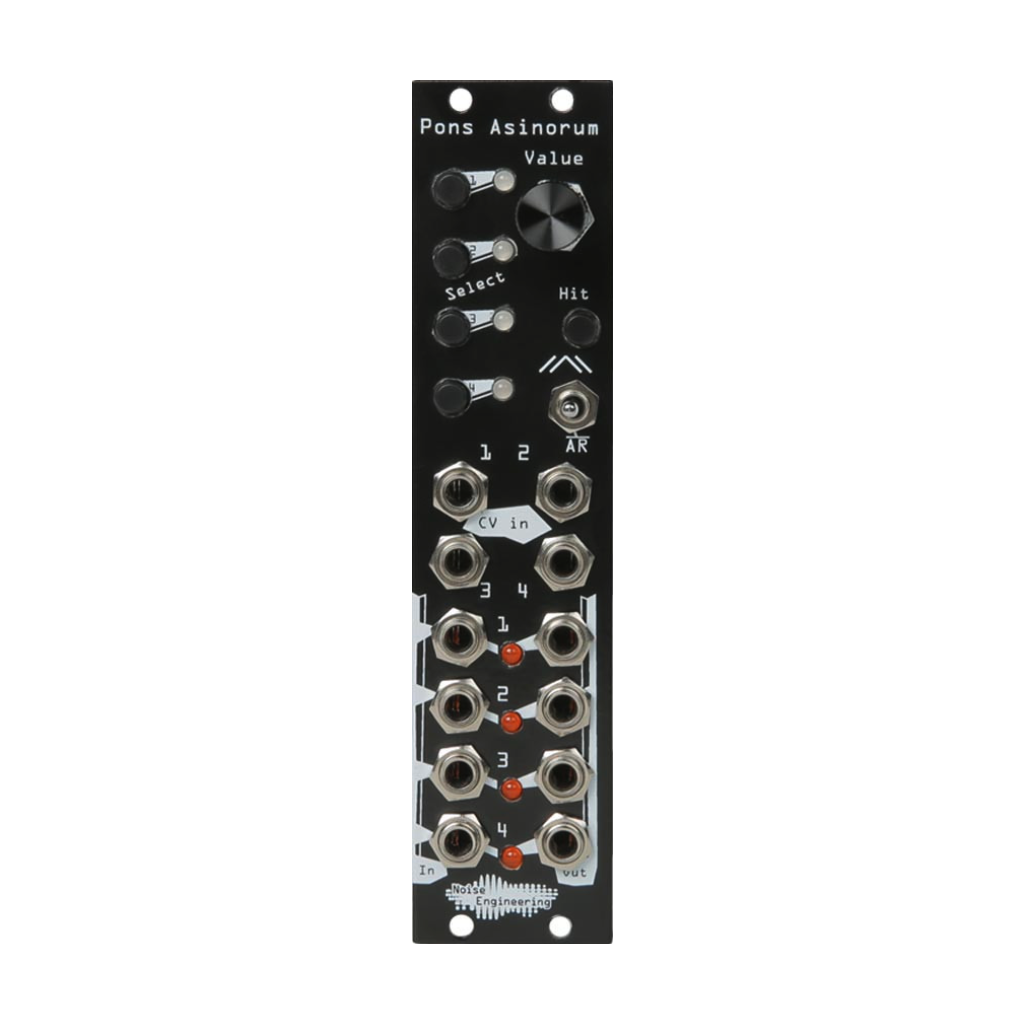
Noise Engineering Pons Asinorum
Killer for side-chaining. it starts at zero and ramps up to max voltage, staying there until it gets another gate. You can adjust the ramp (attack) speed to fit your mix, and you’re not limited to ducking volume, you can sidechain anything. It gives you the most control with the fewest hoops to jump through.
Perfect Circuit Signal SoundsYou’re kind of done
There’s plenty more you could do to clean up your mix, but if you’ve made it this far, you’ve already handled the worst of the mess. These changes alone will make a huge difference.
That said, if you want to go the extra mile, here are a few more tricks worth trying.
If everything’s big, nothing is
Not every voice should be huge or harmonically rich. If everything is thick, then nothing stands out. Try balancing complex textures with simpler ones. One voice can be a big, distorted wavetable monster, another might be a basic sine or triangle. Dry sounds next to wet ones. Harsh sounds next to smooth. Give the ear something to latch onto.
Mono is not a dirty word
Stereo is great, but too many wide signals can smear your whole mix. If everything’s spread, there’s no center. Collapse some voices to mono, especially basses, kicks, and anything that should anchor your sound. You’ll be surprised how much more focused everything feels.
Phase check before you wreck
If a voice when played on its own sounds good, but when played in the mix feels weak or hollow, you might be dealing with phase cancellation, especially if you’re stacking multiple oscillators or using stereo effects. Try inverting a waveform, changing pulse width, detuning differently, or even shifting timing slightly. Trust your ears over your scope.
Make room or get out of the way
One easy fix for muddiness? Don’t let all your voices hit at the same time. Try shorter decay envelopes. Stagger note triggers. Use rhythmic separation or level modulation to let some sounds win over others. You can also use sidechaining to duck a sound, allowing space for the one you want. The classic is to duck your bass when your kick hits.
Silence is a power move
If a voice doesn’t serve the patch, yank the cable. Or better, mute it and listen again. If you don’t miss it, it was just taking up headroom. Modular makes it easy to pile things on, but clarity often comes from doing less.
Polish, don’t sterilize
You don’t need to strip the soul out of your patch to clean it up. Just be intentional. A little filtering, some thoughtful contrast, and a sense of space go a long way. Don’t settle for soup when you could have something sharp, clean, and punchy.