

When I was just starting out with synths, having owned a few hardware units and many soft-synths, I often saw the letters VCA. All I knew was that the envelope connected to this VCA would change its volume. So, a VCA is just a volume knob, right? Well, yes, but there’s more to it. Let’s dive into the many uses of VCAs, and soon you’ll understand why “you can never have too many VCAs” isn’t just a cliché.
WTF is a VCA anyway?
Starting with the basics, a VCA (voltage-controlled amplifier) in synthesizers is a module that changes the amplitude of an incoming signal using a potentiometer (pot) or control voltage (CV). Let’s break that down.
A basic VCA module has three parts:
- Input: Where you plug in the source signal you want controlled by the VCA.
- CV input: Where you plug in the control signal that sets the VCA’s level.
- Output: Where your amplitude-modified source signal exits the module.
Here’s where it gets tricky: both the input and the CV input accept audio or CV, and the output passes whatever is at the input, modulated by whatever is at the CV input. I’ll clarify as we go deeper.
I use “amplitude” instead of “volume” because VCAs handle both CV and audio. Since CV isn’t audible, “volume” isn’t always the right term.
A VCA without a control signal usually won’t pass the input source to the output. Think of a VCA like a light switch in the off position. The control signal tells the VCA to open, much like flipping a switch to see the light. You can think of CV as your hand flipping the light switch on and off. CV tells your VCA to open and close.
Some VCAs have a pot to manage the CV input, like a dimmer for lights. The pot controls the level of CV that passes and controls the VCA.
On some VCAs, the CV input is normalled to an internal voltage set by the pot. With nothing patched to the CV input, the pot sets a static level that opens the VCA and lets the input signal pass to the output.
There are many more VCA configurations, but this covers a lot of the VCAs available today.
Phew, that was a lot! But now you have a solid foundation to understand how to use VCAs in different ways. Let’s get patching!
Knobulism recommends
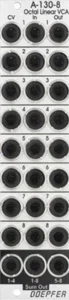
Doepfer A-130-8
Eight linear VCAs and 3 unity mix outputs in just 6hp. No bias pots, but I liked it enough to own two.
Perfect Circuit Signal Sounds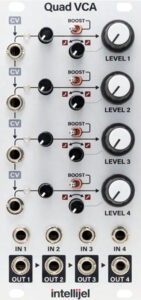
Intellijel Quad VCA
Variable response curves, gain boost, mixing, and cascading normalized CV inputs, all in one module.
Perfect Circuit Signal Sounds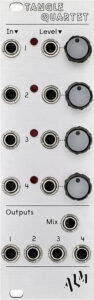
ALM Tangle Quartet
My fave before the A-130-8 and still a keeper. A clean, simple mixer with 4 linear VCAs in just 8hp.
Perfect Circuit Signal SoundsBasic VCA patches
Simple modulation sources
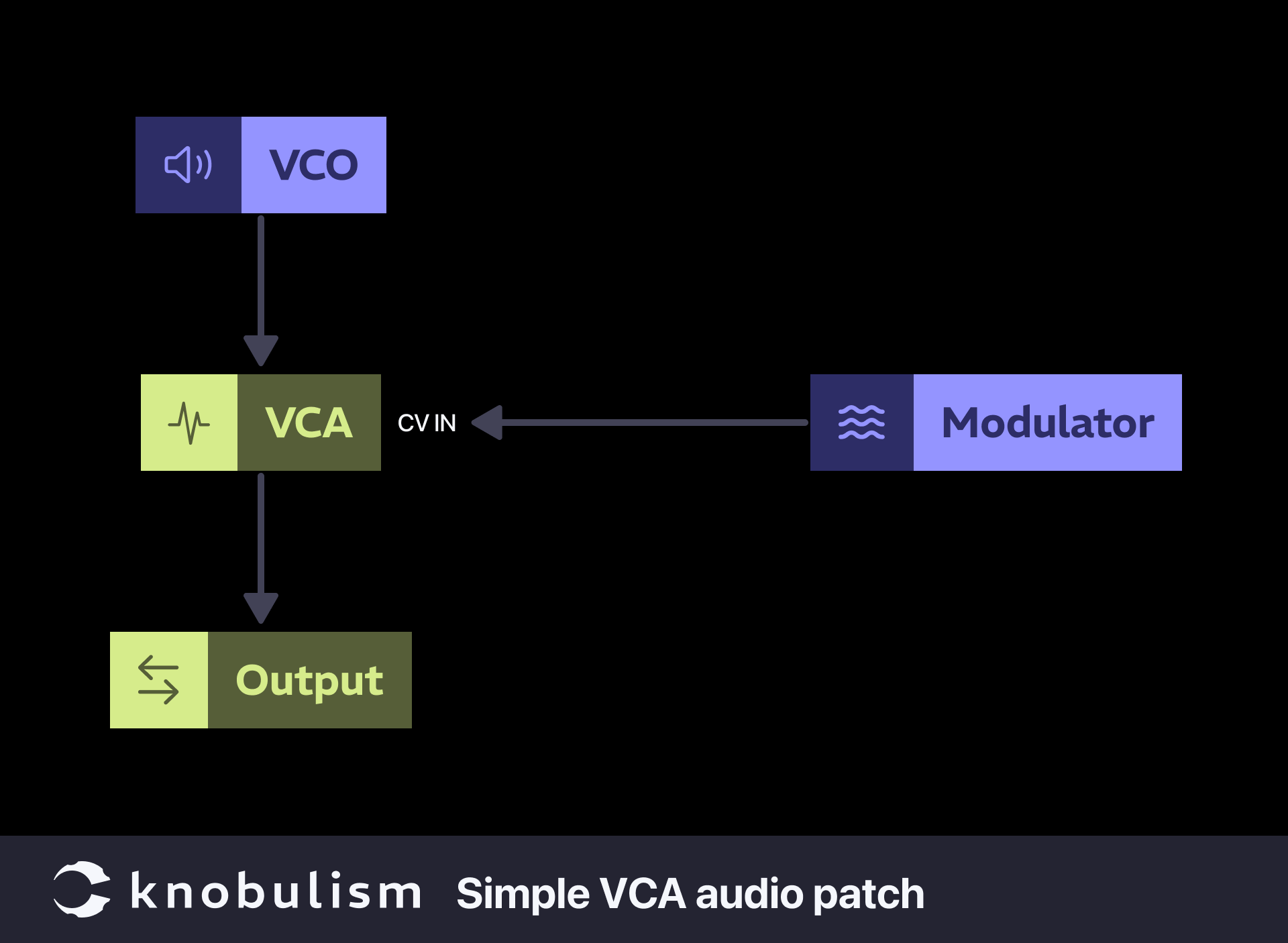
The most common use of a VCA in patches is to shape an incoming sound by varying its amplitude. Plug any constant sound source into the input, plug a modulation source into the CV input, and monitor your output. It’s that easy. But please try more than just an envelope.
Amplitude modulation (AM)
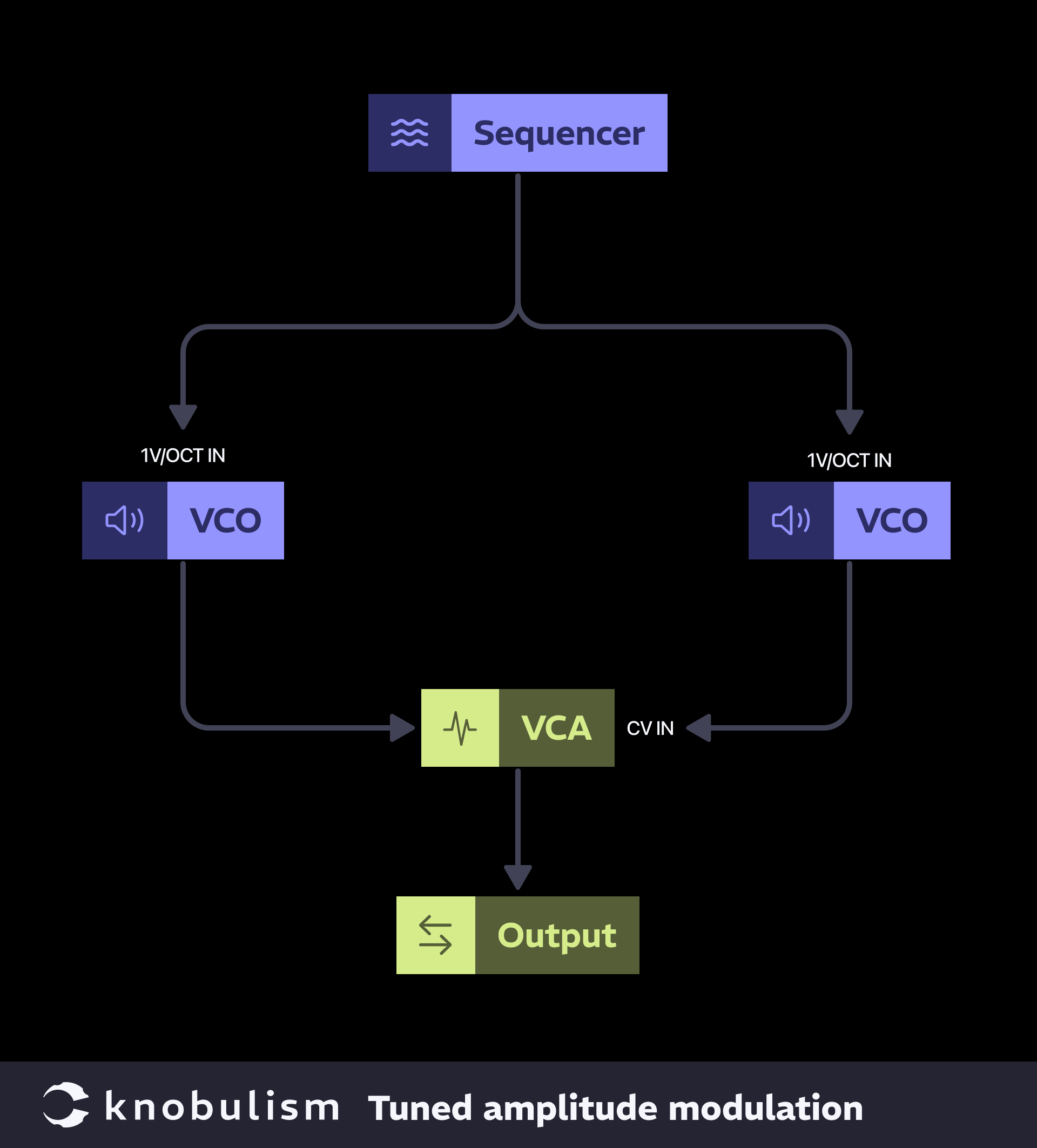
In short, AM uses the signal at the CV input to vary the input signal’s amplitude. At audio rates, this adds sidebands that enrich the timbre, which is useful for creating complex and rhythmic textures.
AND logic
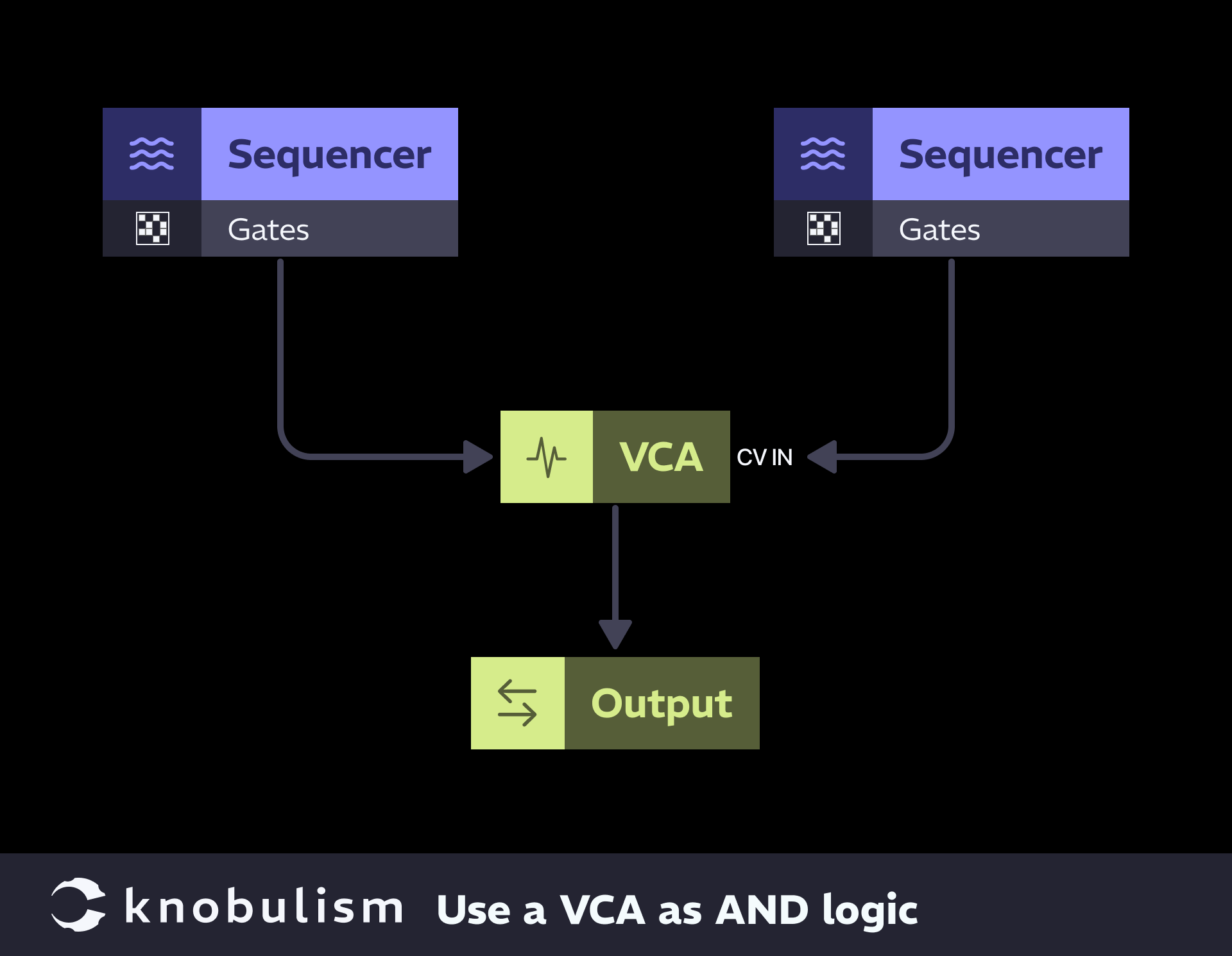
What if you had a really fast, constant gate source and wanted that stream of gates to trigger a snare, but only periodically? That’s where logic modules become useful, and a VCA can easily become an AND logic module.
So, what is AND logic? A logic module takes two gates and outputs a gate only when both are high at the same time. If only one or neither is high, nothing comes out. Let’s try this out. Patch a fast stream of gates into the VCA input and the periodic gate into the CV input. While both are high, the VCA passes the gate stream, which sounds like a ratchet.
Modulate your modulation
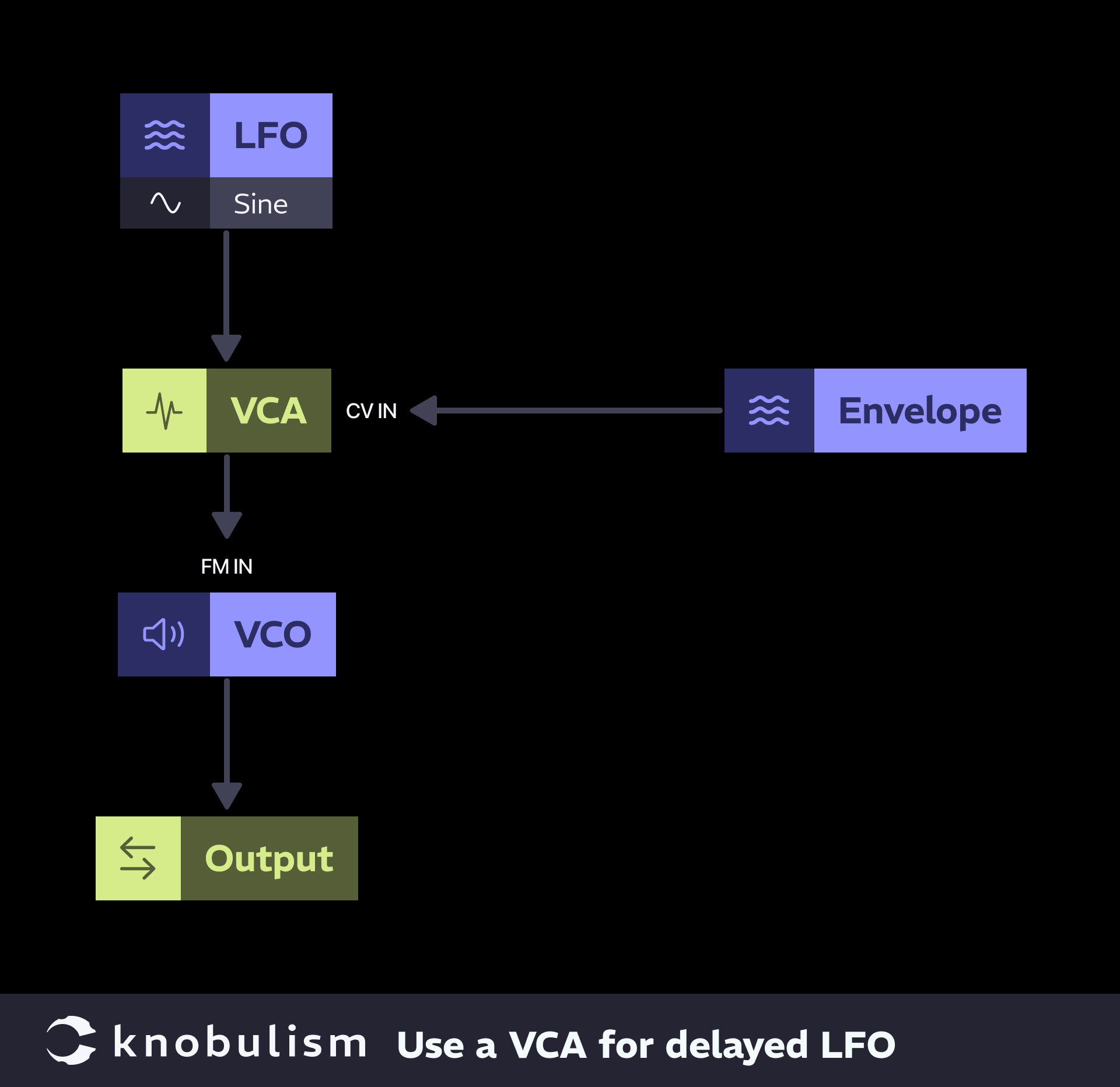
Delayed LFO
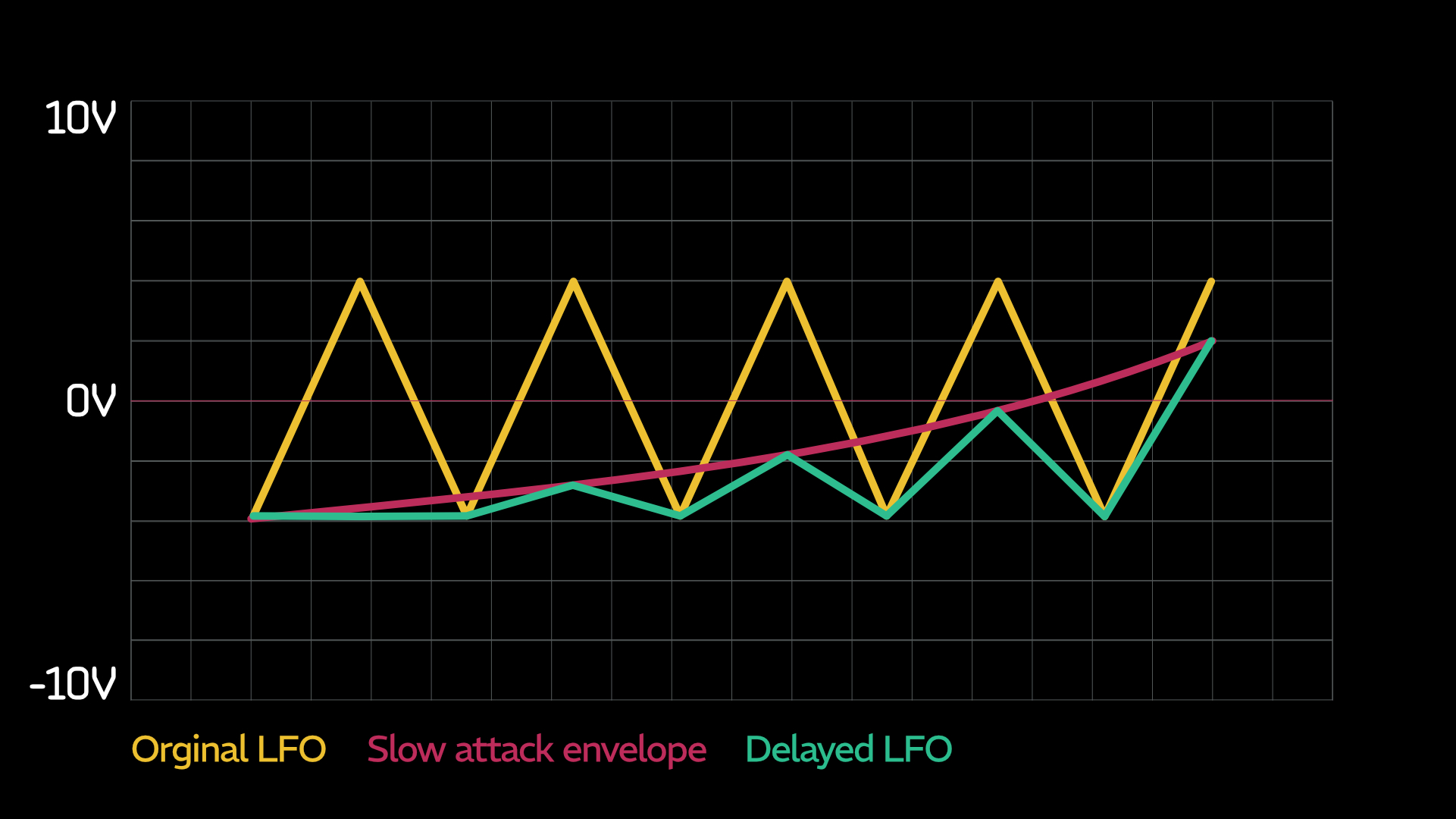
Got a vibrato patch you love but don’t want it to last the entire note? Start the sound smooth and steady, then gradually bring in vibrato toward the end by modulating the LFO’s amplitude with an envelope through a VCA.
Below is an example of what the modified delayed LFO might look like.
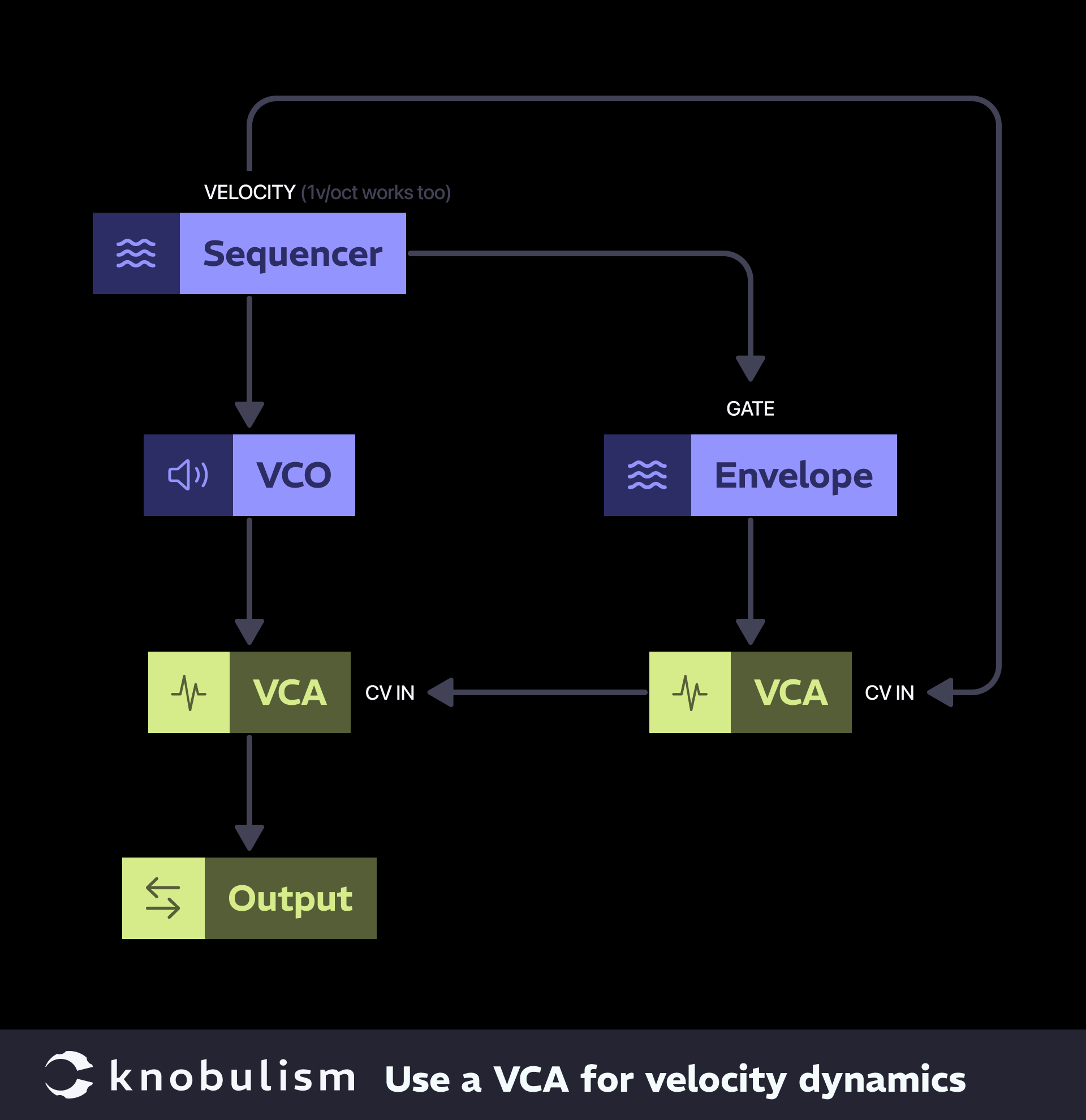
Velocity dynamics
Admit it, your hi-hats are boring. Want to add some feel but only have a straight, clock-divided 8th-note rhythm? Adding volume dynamics can give you the groove you’re looking for.
Modulation index
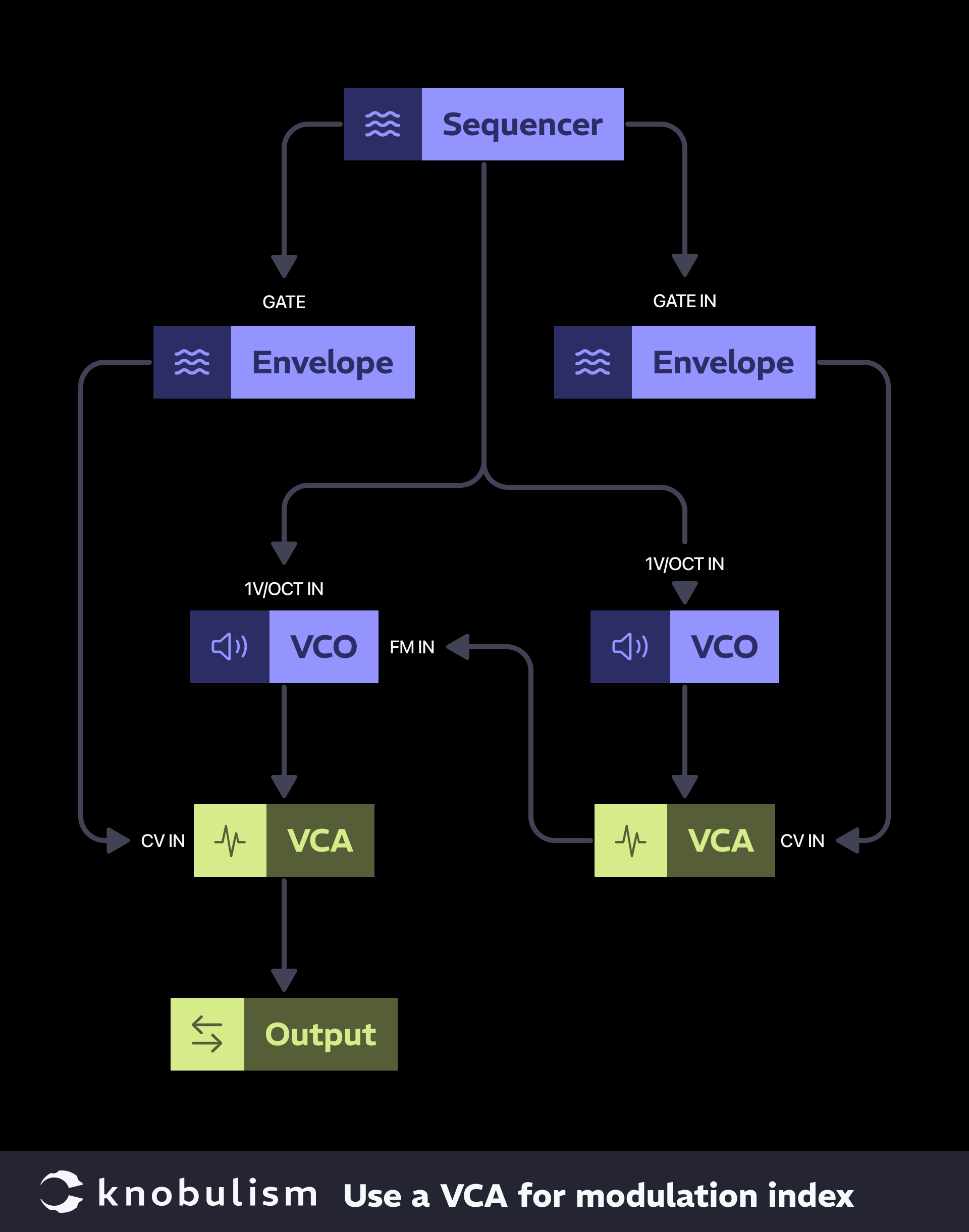
Similar to the previous patches, this one dynamically delivers modulation to create movement and interest. This technique works great for FM, AM, filter cutoff, and more.
Start with an existing patch that has a modulation source. Place a VCA between the modulation source and destination to control when it happens.
Voltage-controlled panning or crossfading
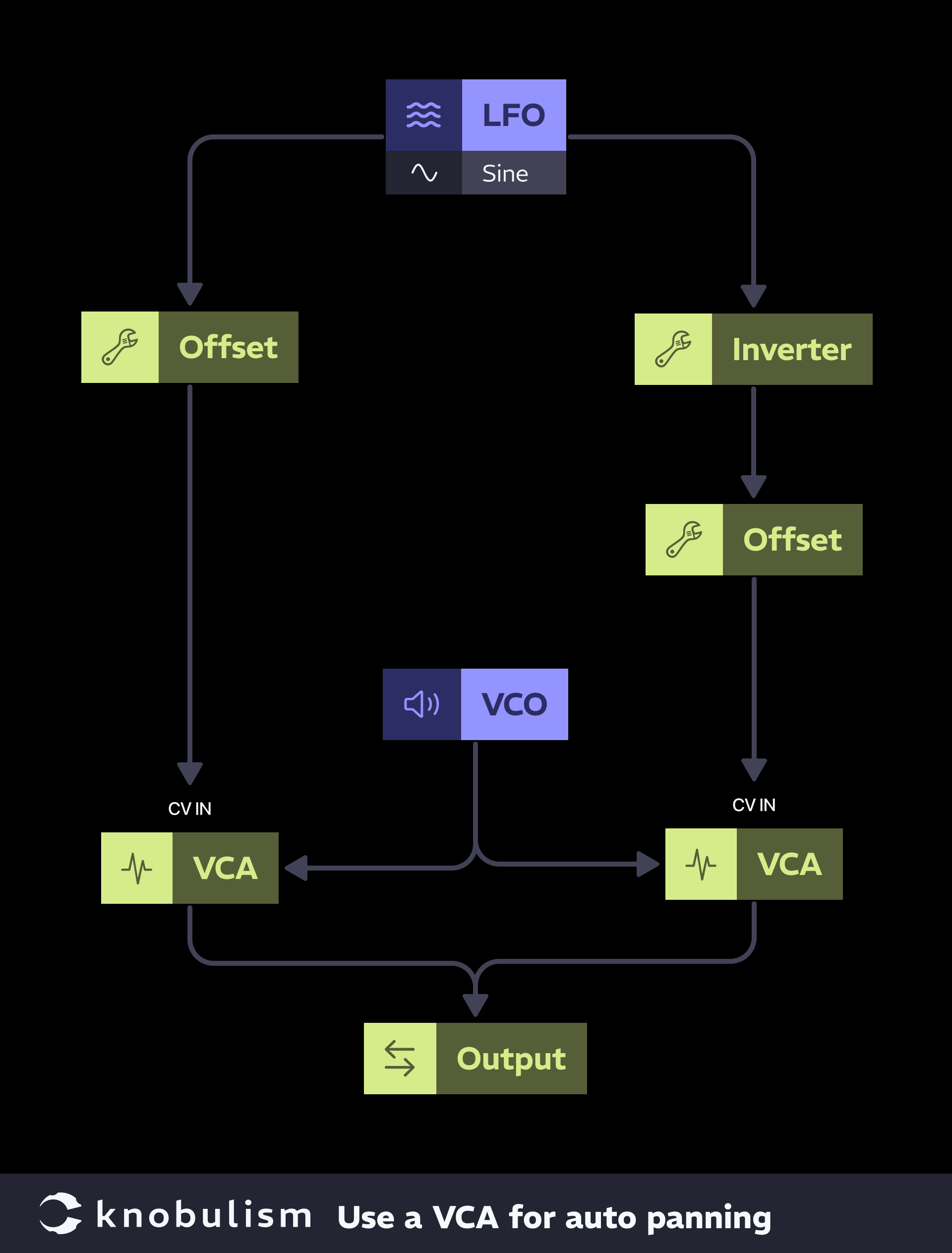
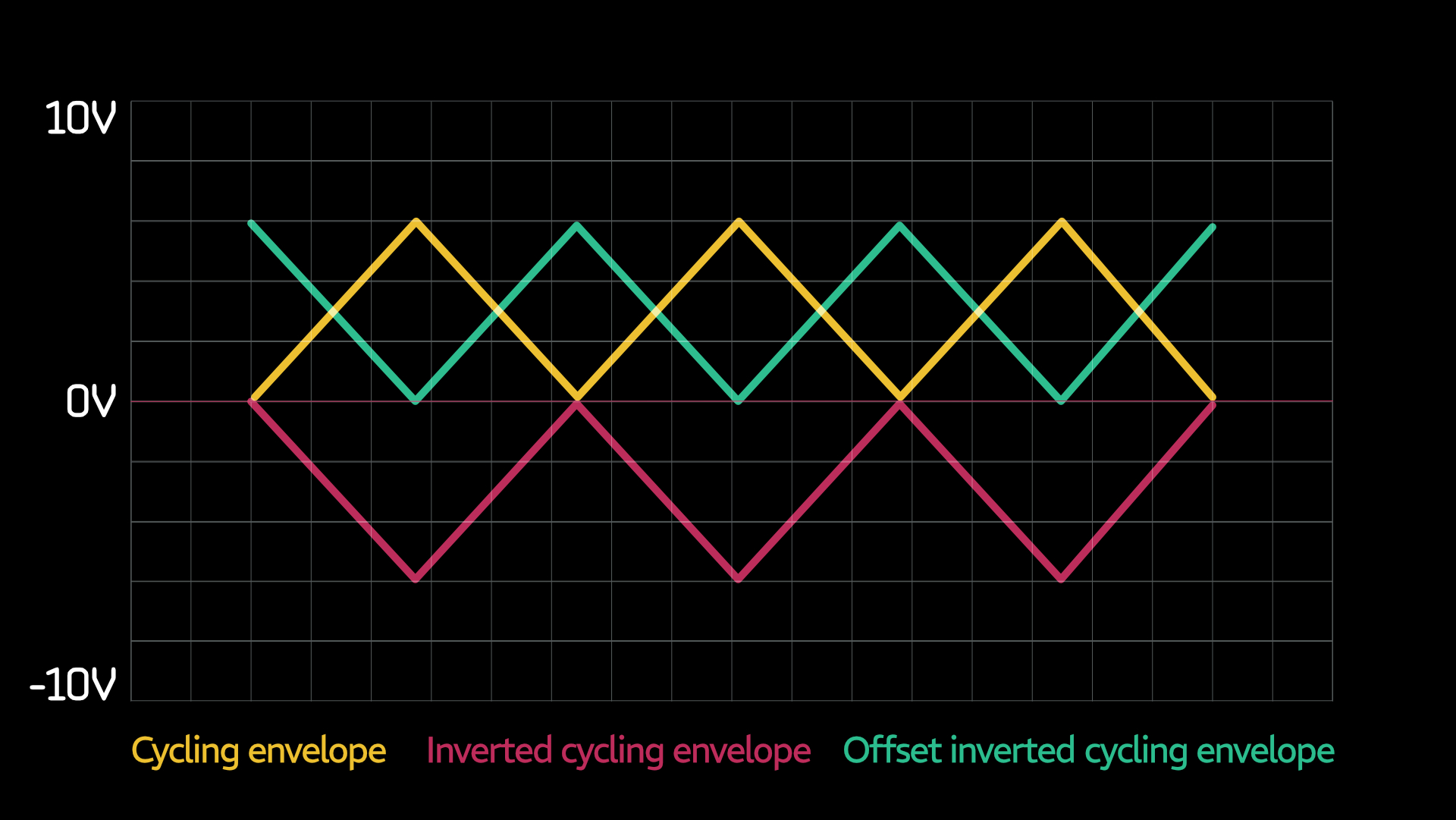
To move a sound source left or right in a stereo field, grab two VCAs and mult your source sound to each input. Then use a modulation signal like a triangle LFO to automate the panning or crossfading. The trick is to mult your modulation and invert one copy. When you do this, you’ll likely have to offset the inverted copy so it sits in the same positive range as the original. With a unipolar signal like an envelope, you only need to offset the inverted copy. With a bipolar signal, you’ll likely need to offset both so their crossover point isn’t below zero.
Below is a chart that illustrates why the inverted signal needs an offset. You can clearly see the inverted envelope sits entirely below 0V. Most standard VCAs ignore negative CV, so that red line does nothing until it’s offset.
This certainly does not cover everything a VCA can do. But I hope it serves as a starting point for understanding the fundamental uses of VCAs and how they can make your patches way more interesting.
Let me know in the comments how these patches go for you, or ask any questions there.


This information is very inspiring and definitely has helped me in understanding how my doepfer octal vca works and what it can do. Thank YOU so much!