
What is a Benjolin?
You may already be mesmerized by the Benjolin or maybe you’ve wondered what the big deal is. No matter your position, the Benjolin is a work of artistic genius. Invented by Dutch synth master Rob Hordijk, the Benjolin is a playful, chaotic, and unique synthesizer. It is by far one of my favorites.
I wanted to understand more intimately what was going on behind the panel. So I scoured the internet for diagrams and explanations. My goal is to lay it out in simple and straightforward way that I did not come across in my search.
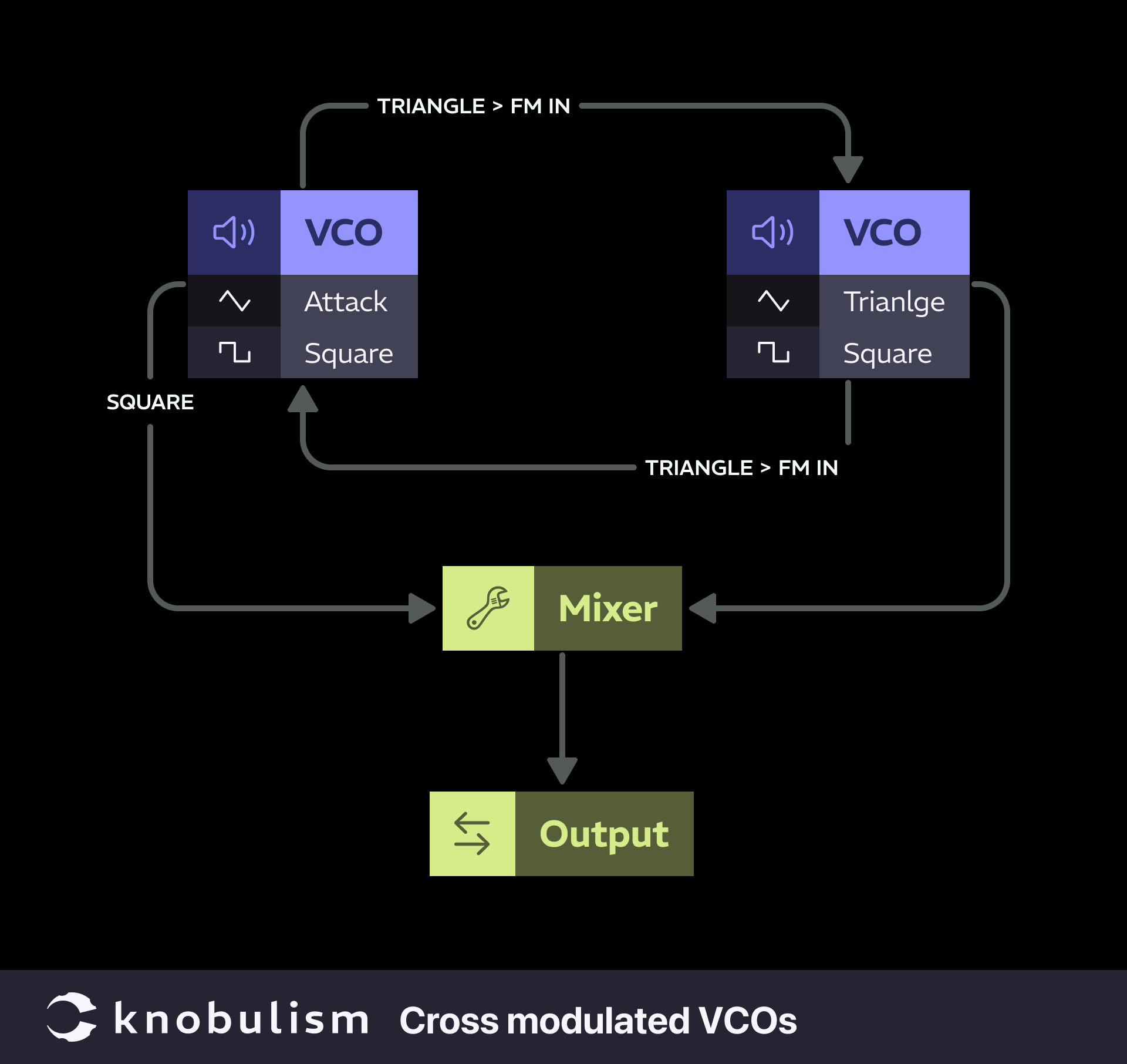
In its most basic form, the Benjolin is a chaotic feedback system between two oscillators. Their signals are routed back and forth between each other. Start there by listening to the output of two cross-modulated oscillators as seen in this patch.
I am certain you now understand just how chaotic things can get. Let’s expand this patch into the full chaos core and beating heart of the Benjolin. To do this, it is best to use a shift register. However, not many folks have one lying around, so you can substitute a sample and hold. Just send the square wave from osc B to the trigger input and the triangle to the in/sample input of the sample and hold.
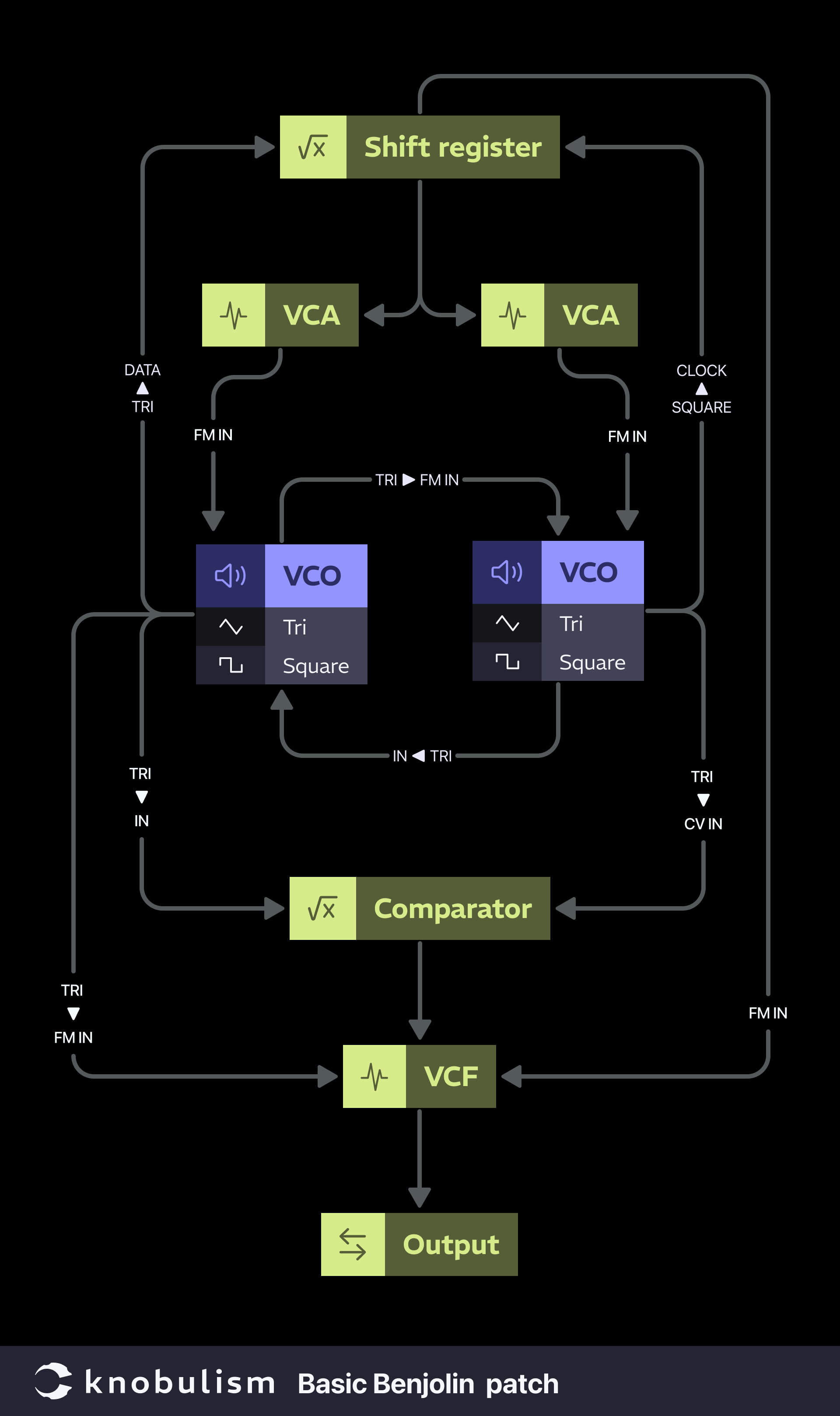
You should now understand some of the crazy sounds a Benjolin can produce. Now it is time to tame this beast and put these features under voltage control. All we are going to do is add VCAs in between the feedback signals and their destination. Attenuators would also work here, but the advantage of a VCA is you can automate the signal level rather than just setting it and forgetting it.
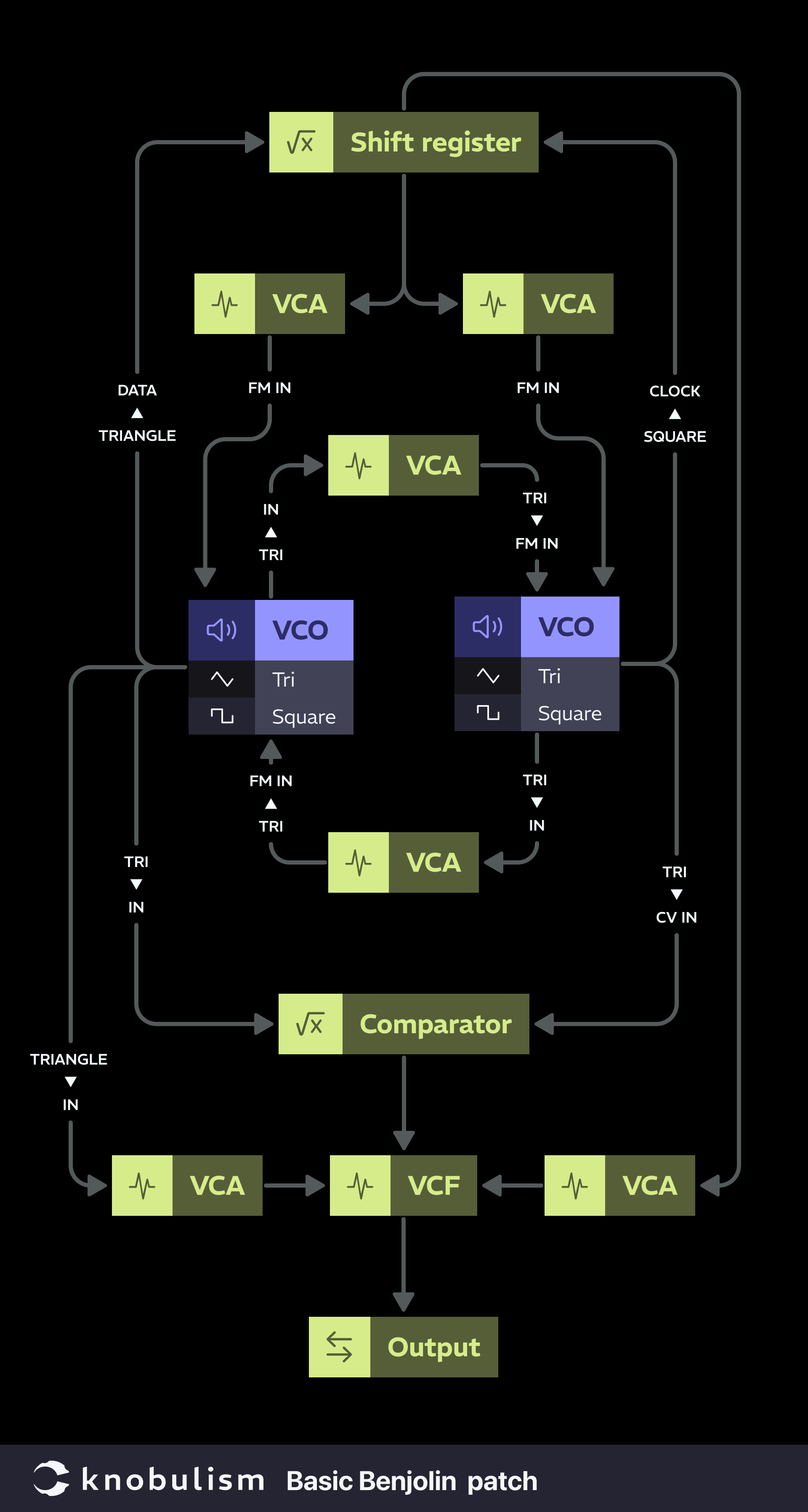
There is a little more to the Benjolin, like being able to lock and loop the shift register output to achieve repeating patterns. This is, however, the bones behind the Benjolin and should give you a great understanding of what’s happening. Also, I hope it uncovers some ideas about generative patching. Feel free to expand the patch or just share some of the sounds you make in the comments below.